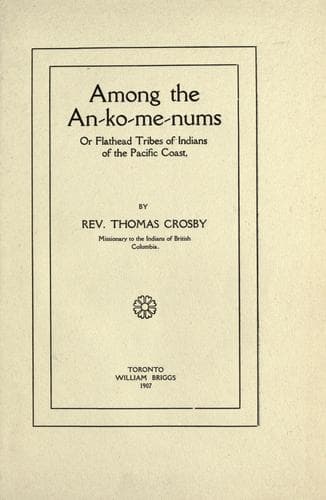
Among the An-ko-me-nums, or Flathead Tribes of Indians of the Pacific CoastCrosby, Thomas
History
Among the An-ko-me-nums, or Flathead Tribes of Indians of the Pacific Coast
Crosby, Thomas
Indians of North America -- Missions; Salish Indians
If the Church were only awake to her privilege, and the responsibility
which God has thrown upon her by the wealth He has placed in her hands,
and, as a faithful steward, would return a tithe of what He has given
for the spread of His Kingdom, we should soon have enough to carry the
Gospel to every creature.
FOOTNOTES:
[1] Dr. Hinds’ Life of Jason Lee.
[2] Some years later two Roman Catholic priests, one of whom was Father
Demers, found their way to the Columbia River, and still later Demers
journeyed into the Okanagan Valley, and commenced work among the
Shuswaps.
CHAPTER II. _THE CALL FROM MACEDONIA._
“I will send a Prophet to you,
A Deliverer of the Nations--
Who shall guide you and shall teach you,
Who shall toil and suffer with you.
If you listen to his counsels,
You will multiply and prosper;
If his warnings pass unheeded,
You will fade away and perish!”
_Longfellow’s “Hiawatha.”_
On the Columbia River, and farther north, on the shores of Puget Sound
and the lower part of Vancouver Island, where the Hudson’s Bay Company
had established one of their most important posts--Fort Victoria or
Camosun--small settlements gradually sprang up. But these were of
little consequence until, in the year 1858, the discovery of gold on
the bars of the Fraser, and later in Cariboo, drew attention to British
Columbia and led to a wild rush from all parts of the world to the new
“diggings.”
Almost immediately the Methodist Church embraced the opportunity, and
sent out the first band of missionaries to the Pacific Coast, in the
persons of Revs. Ephraim Evans, D.D., Edward White, Ebenezer Robson and
Arthur Browning. These brethren were speedily at work, at Victoria and
Nanaimo on Vancouver Island, and at New Westminster and Hope on the
Fraser River.
While the hearts of these faithful missionaries were much engaged with
the needs of the white inhabitants, their souls were stirred with the
scenes of degradation and misery constantly presented to them by the
wild native population, and their liveliest sympathies were aroused
with a desire to help them. Brother Robson, especially, endeavored, as
the circumstances of his own work permitted, to reach the Indians, both
at Hope and Nanaimo. But the pressure of the ever-widening field among
the whites made it impossible to do a great deal, and led him, with the
others, to pray and plead that someone might be raised up whose mission
would be the salvation of the Indians.
Public-domain text, read in full here on John Shaqi.
Reviews
Reviews
No reviews yet
Be the first to share your thoughts on this work.
Join the Discussion
Join the discussion
Sign in to leave a comment or review.
Sign InorCreate an account