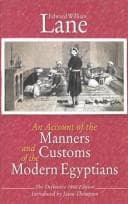
An account of the manners and customs of the modern EgyptiansLane, Edward William
History
An account of the manners and customs of the modern Egyptians
Lane, Edward William
Egypt -- Social life and customs
Misled by the decision of those doctors, and an opinion prevalent in
Europe, I represented the laws of “holy war” as more severe than I
find them to be according to the letter and spirit of the Kur-án, when
carefully examined, and according to the Hanafee code. I am indebted
to Mr. Urquhart for suggesting to me the necessity of revising my
former statement on this subject; and must express my conviction that
no precept is to be found in the Kur-án which, taken with the context,
can justify unprovoked war.
Footnote 165:
Kur-án, chap. ii., _v._ 216. A kind of wine, formerly called “nebeedh”
(a name now given to prohibited kinds), may be lawfully drunk. This is
generally an infusion of dry grapes, or dry dates. The Muslims used to
keep it until it had slightly fermented; and the Prophet himself was
accustomed to drink it, but not when it was more than two days old.
The nebeedh of raisins is now called “zebeeb.”
Footnote 166:
A similar beverage, thus prepared from barley, was used by the ancient
Egyptians. (Herodotus, lib. ii., cap. 77.) The modern inhabitants of
Egypt also prepare boozeh from wheat and from millet in the same
manner, but less commonly.
Footnote 167:
Swine were universally deemed impure by the ancient Egyptians
(Herodotus, lib. ii., cap. 47.)
Footnote 168:
Kur-án, chap. v., _v._ 4.
Footnote 169:
The Arabic words of this prayer, “God give thee patience,” etc., are,
“Allah yesabbirak (for yusabbirak) ’ala má belák.”
Footnote 170:
In some respects the Muslim code does not appear to be so strictly
founded upon exigencies of a sanatory nature as the Mosaic. See
Leviticus xi. 9-12. In Egypt, fish which have not scales are generally
found to be unwholesome food. One of the few reasonable laws of
El-Hákim was that which forbade the selling or catching such kinds of
fish. See De Sacy, “Chrestomathie Arabe,” 2nde ed., tome i., p. 98.
Footnote 171:
It is unlawful to give or receive interest, however small, for a loan,
or on account of credit; and to exchange any article for another
article of the same species, but differing in quantity. These and
several other commercial transactions of a similar kind are severely
condemned; but they are not very uncommon among modern Muslims, some
of whom take exorbitant interest.
Footnote 172:
Many of the Muslims hold that only sculptures which cast a shadow,
representing living creatures, are unlawful; but the Prophet certainly
condemned pictures also.
Footnote 173:
A law given in the Kur-án is called “fard.”
Footnote 174:
A law derived from the Traditions is called “sunneh.”
Footnote 175:
Kur-án, chap. iv., _v._ 3.
Footnote 176:
Public-domain text, read in full here on John Shaqi.
Reviews
Reviews
No reviews yet
Be the first to share your thoughts on this work.
Elsewhere in the archive
Join the Discussion
Join the discussion
Sign in to leave a comment or review.
Sign InorCreate an account