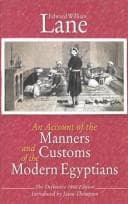
An account of the manners and customs of the modern EgyptiansLane, Edward William
History
An account of the manners and customs of the modern Egyptians
Lane, Edward William
Egypt -- Social life and customs
In another case, when the Kádee and the council of the ’Ulama were
influenced in their decision by a Básha (not Mohammad ’Alee), and passed
a sentence contrary to law, they were thwarted in the same manner by
El-Mahdee. This Muftee was a rare example of integrity. It is said that
he never took a fee for a fetwa. He died shortly after my first visit to
this country.—I could mention several other glaring cases of bribery in
the court of the Kádee of Cairo; but the above is sufficient.
There are five minor Mahkem′ehs in Cairo; and likewise one at its
principal port, Boolák; and one at its southern port, Masr El-’Ateekah.
A Sháhid from the great Mahkem′eh presides at each of them, as deputy of
the chief Kádee, who confirms their acts. The matters submitted to these
minor tribunals are chiefly respecting the sales of property, and
legacies, marriages, and divorces; for the Kádee marries female orphans
under age who have no relations of age to act as their guardians; and
wives often have recourse to law to compel their husbands to divorce
them. In every country-town there is also a Kádee, generally a native of
the place, and never a Turk, who decides all cases, sometimes from his
own knowledge of the law, but commonly on the authority of a Muftee. One
Kádee generally serves for two or three or more villages.
Each of the four orthodox sects of the Muslims (the Hanafees, Sháfe’ees,
Málikees, and Hambel′ees) has its “Sheykh,” or religious chief, who is
chosen from among the most learned of the body, and resides in the
metropolis. The Sheykh of the great mosque El-Azhar (who is always of
the sect of the Sháfe’ees, and sometimes Sheykh of that sect), together
with the other Sheykhs above mentioned, and the Kadee, the Nakeeb
el-Ashraf (the chief of the Shereefs, or descendants of the Prophet),
and several other persons, constitute the council of the ’Ulama[217] (or
learned men), by whom the Turkish Báshas and Memlook chiefs have often
been kept in awe, and by whom their tyranny has frequently been
restricted: but now this learned body has lost almost all its influence
over the government. Petty disputes are often, by mutual consent of the
parties at variance, submitted to the judgment of one of the four
Sheykhs first mentioned, as they are the chief Muftees of their
respective sects; and the utmost deference is always paid to them.
Difficult and delicate causes, which concern the laws of the Kur-án or
the Traditions, are also frequently referred by the Básha to these
Sheykhs; but their opinion is not always followed by him: for instance,
after consulting them respecting the legality of dissecting human
bodies, for the sake of acquiring anatomical knowledge, and receiving
their declaration that it was repugnant to the laws of the religion, he,
nevertheless, has caused it to be practised by Muslim students of
anatomy.
Public-domain text, read in full here on John Shaqi.
Reviews
Reviews
No reviews yet
Be the first to share your thoughts on this work.
Elsewhere in the archive
Join the Discussion
Join the discussion
Sign in to leave a comment or review.
Sign InorCreate an account