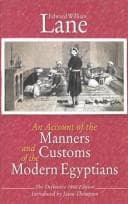
An account of the manners and customs of the modern EgyptiansLane, Edward William
History
An account of the manners and customs of the modern Egyptians
Lane, Edward William
Egypt -- Social life and customs
secretary to write the names of the sixty men, and an order to the
sheykh of their village to bring them to Manoof, where this complaint
was made. The Názir and butcher were placed in confinement till the next
morning; when the sheykh of the village came, with the sixty felláheen.
The two prisoners were then brought again before the Deftardár, who said
to the sheykh and the sixty peasants, “Was the value of this man’s cow
sixty riyáls?” “O our master,” they answered, “her value was greater.”
The Deftardár sent for the Kádee of Manoof, and said to him, “O Kádee,
here is a man oppressed by this Názir, who has taken his cow, and killed
it; and sold its flesh for sixty riyáls. What is thy judgment?” The
Kádee replied, “He is a cruel tyrant, who oppresses every one under his
authority. Is not a cow worth a hundred and twenty riyáls, or more? and
he has sold this one for sixty riyáls: this is tyranny towards the
owner.” The Deftardár then said to some of his soldiers, “Take the
Názir, and strip him, and bind him.” This done, he said to the butcher,
“Butcher, dost thou not fear God? Thou hast killed the cow unjustly.”
The butcher again urged that he was obliged to obey the Názir. “Then,”
said the Deftardár, “if I order thee to do a thing, wilt thou do it?” “I
will do it,” answered the butcher. “Slaughter the Názir,” said the
Deftardár. Immediately, several of the soldiers present seized the
Názir, and threw him down; and the butcher cut his throat, in the
regular orthodox manner of killing animals for food. “Now, cut him up,”
said the Deftardár, “into sixty pieces.” This was done: the people
concerned in the affair, and many others, looking on; but none daring to
speak. The sixty peasants who had bought the meat of the cow were then
called forward, one after another, and each was made to take a piece of
the flesh of the Názir, and to pay for it two riyáls; so that a hundred
and twenty riyáls were obtained from them. They were then dismissed; but
the butcher remained. The Kádee was asked what should be the reward of
the butcher; and answered that he should be paid as he had been paid by
the Názir. The Deftardár therefore ordered that the head of the Názir
should be given to him; and the butcher went away with his worse than
valueless burden, thanking God that he had not been more unfortunate,
and scarcely believing himself to have so easily escaped until he
arrived at his village. The money paid for the flesh of the Názir was
given to the owner of the cow.
Public-domain text, read in full here on John Shaqi.
Reviews
Reviews
No reviews yet
Be the first to share your thoughts on this work.
Elsewhere in the archive
Join the Discussion
Join the discussion
Sign in to leave a comment or review.
Sign InorCreate an account