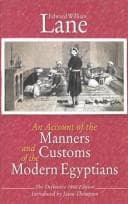
An account of the manners and customs of the modern EgyptiansLane, Edward William
History
An account of the manners and customs of the modern Egyptians
Lane, Edward William
Egypt -- Social life and customs
The respect which most modern Muslims pay to their Prophet is almost
idolatrous. They very frequently swear by him; and many of the most
learned, as well as the ignorant, often implore his intercession.
Pilgrims are generally much more affected on visiting his tomb than in
performing any other religious rite. There are some Muslims who will not
do anything that the Prophet is not recorded to have done: and who
particularly abstain from eating anything that he did not eat, though
its lawfulness be undoubted. The Imám Ahmad Ibn-Hambal would not even
eat water-melons, because, although he knew that the Prophet ate them,
he could not learn whether he ate them with or without the rind, or
whether he broke, bit, or cut them: and he forbade a woman, who
questioned him as to the propriety of the act, to spin by the light of
torches passing in the street by night, which were not her own property,
because the Prophet had not mentioned whether it was lawful to do so,
and was not known to have ever availed himself of a light belonging to
another person without that person’s leave.—I once, admiring some very
pretty pipe-bowls, asked the maker why he did not stamp them with his
name. He answered “God forbid! My name is Ahmad” (one of the names of
the Prophet): “would you have me put it in the fire?”—I have heard
adduced as one of the subjects of complaint against the present Básha,
his causing the camels and horses of the government to be branded with
his names, “Mohammad ’Alee.” “In the first place,” said a friend of
mine, who mentioned this fact to me, “the iron upon which are engraved
these names, names which ought to be so much venerated, the names of the
Prophet (God favour and preserve him!), and his Cousin (may God be well
pleased with him!), is put into the fire, which is shocking: then it is
applied to the neck of a camel; and causes blood, which is impure, to
flow, and to pollute the sacred names both upon the iron and upon the
animal’s skin: and when the wound is healed, how probable is it, and
almost certain and unavoidable, that the camel will, when he lies down,
lay his neck upon something unclean!”
Public-domain text, read in full here on John Shaqi.
Reviews
Reviews
No reviews yet
Be the first to share your thoughts on this work.
Elsewhere in the archive
Join the Discussion
Join the discussion
Sign in to leave a comment or review.
Sign InorCreate an account