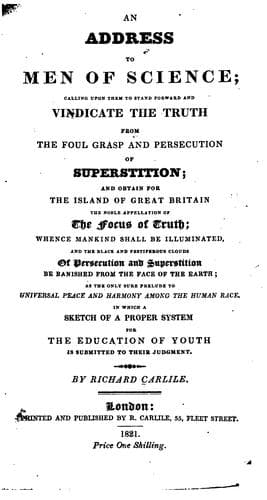
An Address to Men of Science: Calling Upon Them to Stand Forward and Vindicate the Truth....Carlile, Richard
Religion
An Address to Men of Science: Calling Upon Them to Stand Forward and Vindicate the Truth....
Carlile, Richard
Science; Superstition
Whiston was the early friend of Newton and succeeded him at Cambridge in
the professor's chair in the science of the Mathematics. Newton when
young was a firm adherent to the ridiculous doctrine of the Christian
Trinity, and so useful as figures were to him in his mathematical and
astronomical discoveries, and to such an extent, beyond all
predecessors, could he carry them, yet superstition could persuade him,
that three could be explained to be but one; and one to comprise three!
The science of Whiston in the Mathematics was almost equal to that of
Newton, though I believe the former had not so fertile a genius as the
latter, and was obliged to acquire by labour what to the other was
natural. Yet Whiston, although he had superstition enough to make him a
honest and conscientious Christian, knew the proper use of arithmetic,
and would not allow three to be one, nor one to be three: he rejected
the doctrine of the Trinity in the Godhead. Whiston honestly and openly
combated this impossibility, and avowed himself an Arian, and contended
under much persecution throughout his lifetime that such were the
sentiments of the early Christians, and that the doctrine of the Trinity
was but a corruption of the church after it had been long established.
Such tenets were then called blasphemous, and Whiston was expelled from
his professor's chair, and from the university of Cambridge altogether,
and had to endure more clamour about blasphemy than ever I had, or have
any reason to fear in future. This circumstance connected with a rivalry
in the Mathematics occasioned the breach between Whiston and Newton, but
ridiculous as even Whiston's superstition appears to me, I think him a
much more honest man than ever was Newton, and as a member of society
much more useful to the age in which they lived. Newton courted
distinction and popularity by servilely succumbing to all the despotisms
of the day: Whiston was a man of principle, and lived and died poor for
the satisfaction of writing and speaking what he thought and believed.
The one has been too much flattered and applauded; the other too much
vilified and degraded, and the clamour by which both circumstances have
been effected has been equally disgusting and disgraceful to the
country.
Public-domain text, read in full here on John Shaqi.
Reviews
Reviews
No reviews yet
Be the first to share your thoughts on this work.
Join the Discussion
Join the discussion
Sign in to leave a comment or review.
Sign InorCreate an account