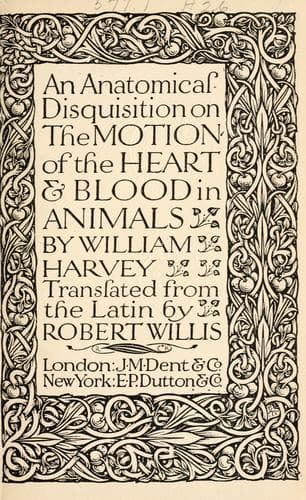
An anatomical disquisition on the motion of the heart & blood in animalsHarvey, William
Science
An anatomical disquisition on the motion of the heart & blood in animals
Harvey, William
Blood -- Circulation
blood-letting in peri-pneumonia and the communication of the veins:
[44] Lib. iii, cap. 6.
“Were it true that the blood naturally passed from the right ventricle
of the heart to the lungs, that it might be carried into the left
ventricle and from thence into the aorta; and were the circulation of
the blood admitted, who does not see that in affections of the lungs
the blood would flow to them in larger quantity and would oppress them,
unless it were taken away, first, freely, and then in repeated smaller
quantities in order to relieve them, which indeed was the advice of
Hippocrates, who, in affections of the lungs takes away blood from
every part--the head, nose, tongue, arms and feet, in order that its
quantity may be diminished and a diversion effected from the lungs; he
takes away blood till the body is almost bloodless. Now admitting the
circulation, the lungs are most readily depleted by opening a vein;
but rejecting it, I do not see how any revulsion of the blood can be
accomplished by this means; for did it flow back by the pulmonary
artery upon the right ventricle, the sigmoid valves would oppose its
entrance, and any escape from the right ventricle into the vena cava
is prevented by the tricuspid valves. The blood, therefore, is soon
exhausted when a vein is opened in the arm or foot, if we admit the
circulation; and the opinion of Fernelius is at the same time upset by
this admission, viz. that in affections of the lungs it is better to
bleed from the right than the left arm; because the blood cannot flow
backwards into the vena cava unless the two barriers situated in the
heart be first broken down.”
He adds yet further in the same place:[45] “If the circulation of the
blood be admitted, and it be acknowledged that this fluid generally
passes through the lungs, not through the middle partition of the
heart, a double circulation becomes requisite; one effected through the
lungs, in the course of which the blood quitting the right ventricle
of the heart passes through the lungs in order that it may arrive at
the left ventricle; leaving the heart on the one hand, therefore, the
blood speedily returns to it again; another and longer circulation
proceeding from the left ventricle of the heart performs the circuit of
the whole body by the arteries, and by the veins returns to the right
side of the heart.”
[45] Lib. iii, cap. 6.
The learned anatomist might here have added a third and extremely short
circulation, viz. from the left to the right ventricle of the heart,
with that blood which courses through the coronary arteries and veins,
and by their ramifications is distributed to the body, walls, and
septum of the heart.
Public-domain text, read in full here on John Shaqi.
Reviews
Reviews
No reviews yet
Be the first to share your thoughts on this work.
Elsewhere in the archive
Join the Discussion
Join the discussion
Sign in to leave a comment or review.
Sign InorCreate an account