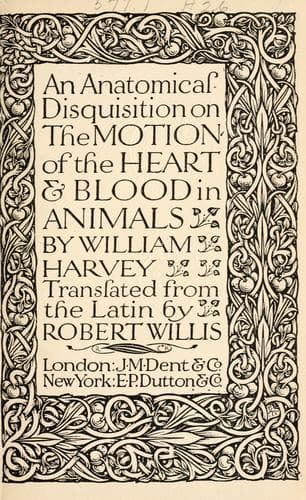
An anatomical disquisition on the motion of the heart & blood in animalsHarvey, William
Science
An anatomical disquisition on the motion of the heart & blood in animals
Harvey, William
Blood -- Circulation
“He who admits one circulation,” proceeds our author, “cannot repudiate
the other;” and he might, as it appears, have added, “the third.” For
why should the coronary arteries of the heart pulsate, if it were not
to force on the blood by their pulsations? and why should there be
coronary veins, the end and office of all veins being to receive the
blood brought by the arteries, were it not to deliver and discharge the
blood sent into the substance of the heart? In this consideration let
it be remembered that a valve is very commonly found at the orifice of
the coronary vein, as our learned author himself admits,[46] preventing
all ingress, but offering no obstacle to the egress of the blood. It
therefore seems that he cannot do otherwise than admit this third
circulation, who acknowledges a general circulation through the body,
and that the blood also passes through the lungs and the brain.[47]
Nor, indeed, can he deny a similar circulation to every other part of
every other region. The blood flowing in under the influence of the
arterial pulse, and returning by the veins, every particle of the body
has its circulation.
[46] Lib. iii, cap. 9.
[47] Lib. iv, cap. 2.
From the words of our learned writer quoted above, consequently, his
opinion may be gathered both of the general circulation, and then of
the circulation through the lungs and the several parts of the body;
for he who admits the first, manifestly cannot refuse to acknowledge
the others. How indeed could he who has repeatedly asserted a
circulation through the general system and the greater vessels, deny a
circulation in the branches continuous with these vessels, or in the
several parts of the second and third regions? as if all the veins,
and those he calls greater circulatory vessels, were not enumerated
by every anatomist, and by himself, as being within the second region
of the body. Is it possible that there can be a circulation which is
universal, and which yet does not extend through every part? Where
he denies it, then, he does so hesitatingly, and vacillates between
negations, giving us mere words. Where he asserts the circulation, on
the contrary, he speaks out heartily, and gives sufficient reasons,
as becomes a philosopher; and then, when he relies on this opinion
in a particular instance, he delivers himself like an experienced
physician and honest man, and, in opposition to Galen and his favourite
Fernelius, advises blood-letting as the chief remedy in dangerous
diseases of the lungs.
Public-domain text, read in full here on John Shaqi.
Reviews
Reviews
No reviews yet
Be the first to share your thoughts on this work.
Elsewhere in the archive
Join the Discussion
Join the discussion
Sign in to leave a comment or review.
Sign InorCreate an account