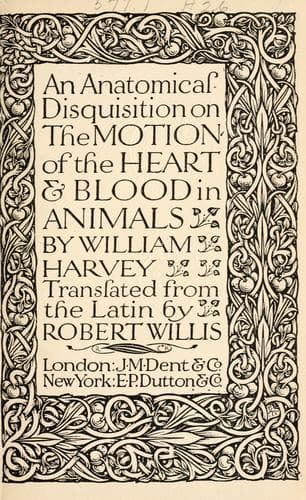
An anatomical disquisition on the motion of the heart & blood in animalsHarvey, William
Science
An anatomical disquisition on the motion of the heart & blood in animals
Harvey, William
Blood -- Circulation
But that the question under discussion, viz. that the pulsific power
does not proceed from the heart by the coats of the vessels, may be
set in yet a clearer light, I beg here to refer to a portion of the
descending aorta, about a span in length, with its division into the
two crural trunks, which I removed from the body of a nobleman, and
which is converted into a bony tube; by this hollow tube, nevertheless,
did the arterial blood reach the lower extremities of this nobleman
during his life, and cause the arteries in these to beat; and yet the
main trunk was precisely in the same condition as is the artery in the
experiment of Galen, when it is tied upon a hollow tube; where it was
converted into bone it could neither dilate nor contract like bellows,
nor transmit the pulsific power from the heart to the inferior vessels;
it could not convey a force which it was incapable of receiving through
the solid matter of the bone. In spite of all, however, I well remember
to have frequently noted the pulse in the legs and feet of this patient
whilst he lived, for I was myself his most attentive physician, and he
my very particular friend. The arteries in the inferior extremities of
this nobleman must therefore and of necessity have been dilated by the
impulse of the blood like flaccid sacs, and not have expanded in the
manner of bellows through the action of their tunics. It is obvious,
that whether an artery be tied over a hollow tube, or its tunics be
converted into a bony and unyielding canal, the interruption to the
pulsific power in the inferior part of the vessel must be the same.
I have known another instance in which a portion of the aorta near
the heart was found converted into bone, in the body of a nobleman, a
man of great muscular strength. The experiment of Galen, therefore,
or, at all events, a state analogous to it, not effected on purpose
but encountered by accident, makes it sufficiently to appear, that
compression or ligature of the coats of an artery does not interfere
with the pulsative properties of its derivative branches; and indeed,
if the experiment which Galen recommends were properly performed by
any one, its results would be found in opposition to the views which
Vesalius believed they would support.
But we do not therefore deny everything like motion to the tunics of
the arteries; on the contrary, we allow them the same motions which we
concede to the heart, viz. a diastole, and a systole or return from the
distended to the natural state; this much we believe to be effected by
a power inherent in the coats themselves. But it is to be observed,
that they are not both dilated and contracted by the same, but by
different causes and means; as may be observed of the motions of all
parts, and of the ventricle of the heart itself, which is distended by
the auricle, contracted by its own inherent power; so, the arteries are
dilated by the stroke of the heart, but they contract or collapse of
themselves.[49]
Public-domain text, read in full here on John Shaqi.
Reviews
Reviews
No reviews yet
Be the first to share your thoughts on this work.
Elsewhere in the archive
Join the Discussion
Join the discussion
Sign in to leave a comment or review.
Sign InorCreate an account