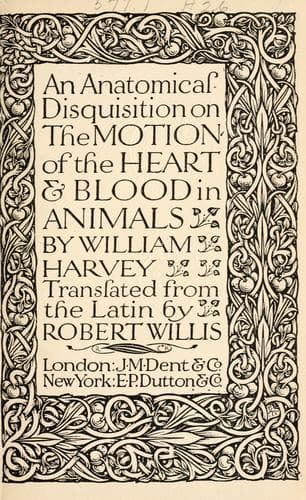
An anatomical disquisition on the motion of the heart & blood in animalsHarvey, William
Science
An anatomical disquisition on the motion of the heart & blood in animals
Harvey, William
Blood -- Circulation
[49] Vide Chapter III. of the Disquisition on the Motion of the Heart
and Blood.
You may also perform another experiment at the same time: if you fill
one of two basins of the same size with blood issuing per saltum from
an artery, the other with venous blood from a vein of the same animal,
you will have an opportunity of perceiving by the eye, both immediately
and by and by, when the blood in either vessel has become cold, what
differences there are between them. You will find that it is not as
they believe who fancy that there is one kind of blood in the arteries
and another in the veins, that in the arteries being of a more florid
colour, more frothy, and imbued with an abundance of I know not what
spirits, effervescing and swelling, and occupying a greater space, like
milk or honey set upon the fire. For were the blood which is thrown
from the left ventricle of the heart into the arteries, fermented into
any such frothy and flatulent fluid, so that a drop or two distended
the whole cavity of the aorta; unquestionably, upon the subsidence of
this fermentation, the blood would return to its original quantity of
a few drops; (and this, indeed, is the reason that some assign for the
usually empty state of the arteries in the dead body;) and so should it
be with the arterial blood in the cup, for so it is with boiling milk
and honey when they come to cool. But if in either basin you find blood
nearly of the same colour, not of very different consistency in the
coagulated state, forcing out serum in the same manner, and filling the
cups to the same height when cold that it did when hot, this will be
enough for any one to rest his faith upon, and afford argument enough,
I think, for rejecting the dreams that have been promulgated on the
subject. Sense and reason alike assure us that the blood contained in
the left ventricle is not of a different nature from that in the right.
And then, when we see that the mouth of the pulmonary artery is of the
same size as the aorta, and in other respects equal to that vessel, it
were imperative on us to affirm that the pulmonary artery was distended
by a single drop of spumous blood, as well as the aorta, and so that
the right as well as the left side of the heart was filled with a brisk
or fermenting blood.
The particulars which especially dispose men’s minds to admit diversity
in the arterial and venous blood are three in number: one, because in
arteriotomy the blood that flows is of a more florid hue than that
which escapes from a vein; a second, because in the dissection of dead
bodies the left ventricle of the heart, and the arteries in general,
are mostly found empty; a third, because the arterial blood is believed
to be more spirituous, and being replete with spirit is made to occupy
a much larger space. The causes and reasons, however, wherefore all
these things are so, present themselves to us when we ask after them.
Public-domain text, read in full here on John Shaqi.
Reviews
Reviews
No reviews yet
Be the first to share your thoughts on this work.
Elsewhere in the archive
Join the Discussion
Join the discussion
Sign in to leave a comment or review.
Sign InorCreate an account