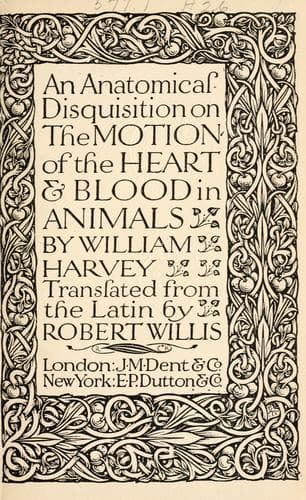
An anatomical disquisition on the motion of the heart & blood in animalsHarvey, William
Science
An anatomical disquisition on the motion of the heart & blood in animals
Harvey, William
Blood -- Circulation
And that no one may seek shelter in asserting that these things are
so when nature is disturbed and opposed, but not when she is left to
herself and at liberty to act; that the same things do not come to pass
in morbid and unusual states as in the healthy and natural condition;
they are to be met by saying, that if it were so, if it happened
that so much blood was lost from the farther orifice of a divided
vein because nature was disturbed, still that the incision does not
close the nearer orifice, from which nothing either escapes or can be
expressed, whether nature be disturbed or not. Others argue in the
same way, maintaining that, although the blood immediately spurts out
in such profusion with every beat, when an artery is divided near the
heart, it does not therefore follow that the blood is propelled by
the pulse when the heart and artery are entire. It is most probable,
however, that every stroke impels something; and that there would be
no pulse of the container, without an impulse being communicated to
the thing contained, seems certain. Yet some, that they may seize upon
a farther means of defence, and escape the necessity of admitting the
circulation, do not fear to affirm that the arteries in the living
body and in the natural state are already so full of blood, that they
are incapable of receiving another drop; and so also of the ventricles
of the heart. But it is indubitable that, whatever the degree of
distension and the extent of contraction of the heart and arteries,
they are still in a condition to receive an additional quantity of
blood forced into them, and that this is far more than is usually
reckoned in grains or drops, seems also certain. For if the ventricles
become so excessively distended that they will admit no more blood,
the heart ceases to beat, (and we have occasional opportunities of
observing the fact in our vivisections,) and, continuing tense and
resisting, death by asphyxia ensues.
In the work on the Motion of the Heart and Blood, I have already
sufficiently discussed the question as to whether the blood in its
motion was attracted, or impelled, or moved by its own inherent nature.
I have there also spoken at length of the action and office, of the
dilatation and contraction of the heart, and have shown what these
truly are, and how the heart contracts during the diastole of the
arteries; so that I must hold those who take points for dispute from
among them as either not understanding the subject, or as unwilling to
look at things for themselves, and to investigate them with their own
senses.[50]
[50] Vide Chapter XIV.
Public-domain text, read in full here on John Shaqi.
Reviews
Reviews
No reviews yet
Be the first to share your thoughts on this work.
Elsewhere in the archive
Join the Discussion
Join the discussion
Sign in to leave a comment or review.
Sign InorCreate an account