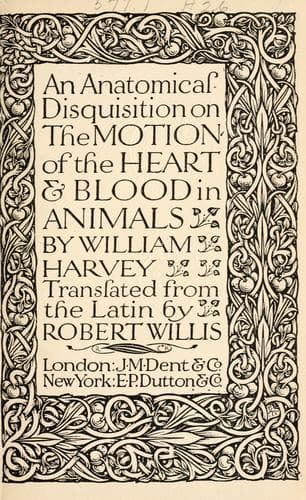
An anatomical disquisition on the motion of the heart & blood in animalsHarvey, William
Science
An anatomical disquisition on the motion of the heart & blood in animals
Harvey, William
Blood -- Circulation
For my part, I believe that no other kind of attraction can be
demonstrated in the living body save that of the nutriment, which
gradually and incessantly passes on to supply the waste that takes
place in the tissues; in the same way as the oil rises in the wick of
a lamp to be consumed by the flame. Whence I conclude that the primary
and common organ of all sensible attraction and impulsion is of the
nature of sinew (nervus), or fibre, or muscle, and this to the end that
it may be contractile, that contracting it may be shortened, and so
either stretch out, draw towards, or propel. But these topics will be
better discussed elsewhere, when we speak of the organs of motion in
the animal body.
To those who repudiate the circulation because they neither see
the efficient nor final cause of it, and who exclaim, cui bono? I
have yet to reply, having hitherto taken no note of the ground of
objection which they take up. And first I own I am of opinion that our
first duty is to inquire whether the thing be or not, before asking
wherefore it is? for from the facts and circumstances which meet us
in the circulation admitted, established, the ends and objects of its
institution are especially to be sought. Meantime I would only ask,
how many things we admit in physiology, pathology, and therapeutics,
the causes of which are unknown to us? That there are many, no one
doubts--the causes of putrid fevers, of revulsions, of the purgation of
excrementitious matters, among the number.
Whoever, therefore, sets himself in opposition to the circulation,
because, if it be acknowledged, he cannot account for a variety
of medical problems, nor in the treatment of diseases and the
administration of medicines, give satisfactory reasons for the
phenomena that appear; or who will not see that the precepts he has
received from his teachers are false; or who thinks it unseemly to give
up accredited opinions; or who regards it as in some sort criminal
to call in question doctrines that have descended through a long
succession of ages, and carry the authority of the ancients;--to all
of these I reply: that the facts cognizable by the senses wait upon no
opinions, and that the works of nature bow to no antiquity; for indeed
there is nothing either more ancient or of higher authority than nature.
Public-domain text, read in full here on John Shaqi.
Reviews
Reviews
No reviews yet
Be the first to share your thoughts on this work.
Elsewhere in the archive
Join the Discussion
Join the discussion
Sign in to leave a comment or review.
Sign InorCreate an account