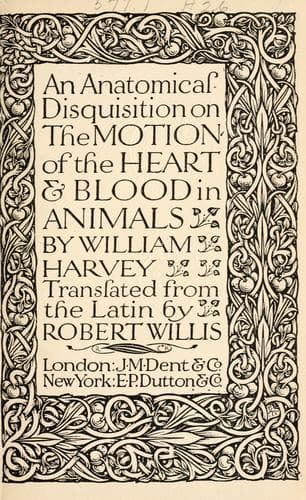
An anatomical disquisition on the motion of the heart & blood in animalsHarvey, William
Science
An anatomical disquisition on the motion of the heart & blood in animals
Harvey, William
Blood -- Circulation
To those who object to the circulation as throwing obstacles in the
way of their explanations of the phenomena that occur in medical
cases (and there are persons who will not be content to take up with
a new system, unless it explains everything, as in astronomy), and
who oppose it with their own erroneous assumptions, such as that,
if it be true, phlebotomy cannot cause revulsion, seeing that the
blood will still continue to be forced into the affected part; that
the passage of excrementitious matters and foul humours through the
heart, that most noble and principal viscus, is to be apprehended;
that an efflux and excretion, occasionally of foul and corrupt blood,
takes place from the same body, from different parts, even from the
same part and at the same time, which, were the blood agitated by a
continuous current, would be shaken and effectually mixed in passing
through the heart, and many points of the like kind admitted in our
medical schools, which are seen to be repugnant to the doctrine of
the circulation,--to them I shall not answer farther here, than that
the circulation is not always the same in every place, and at every
time, but is contingent upon many circumstances: the more rapid or
slower motion of the blood, the strength or weakness of the heart as
the propelling organ, the quantity and quality or constitution of the
blood, the rigidity or laxity of the tissues, and the like. A thicker
blood, of course, moves more slowly through narrower channels; it is
more effectually strained in its passage through the substance of the
liver than through that of the lungs. It has not the same velocity
through flesh and the softer parenchymatous structures and through
sinewy parts of greater compactness and consistency: for the thinner
and purer and more spirituous part permeates more quickly, the thicker
more earthy and indifferently concocted portion moves more slowly, or
is refused admission. The nutritive portion, or ultimate aliment of the
tissues, the dew or cambium, is of a more penetrating nature, inasmuch
as it has to be added everywhere, and to everything that grows and is
nourished in its length and thickness, even to the horns, nails, hair,
and feathers; and then the excrementitious matters have to be secreted
in some places, where they accumulate, and either prove a burthen or
are concocted. But I do not imagine that the excrementitious fluids
or bad humours when once separated, nor the milk, the phlegm, and the
spermatic fluid, nor the ultimate nutritive part, the dew or cambium,
necessarily circulate with the blood: that which nourishes every part
adheres and becomes agglutinated to it. Upon each of these topics and
various others besides, to be discussed and demonstrated in their
several places, viz. in the physiology and other parts of the art of
medicine, as well as of the consequences, advantages or disadvantages
of the circulation of the blood, I do not mean to touch here; it were
Public-domain text, read in full here on John Shaqi.
Reviews
Reviews
No reviews yet
Be the first to share your thoughts on this work.
Elsewhere in the archive
Join the Discussion
Join the discussion
Sign in to leave a comment or review.
Sign InorCreate an account