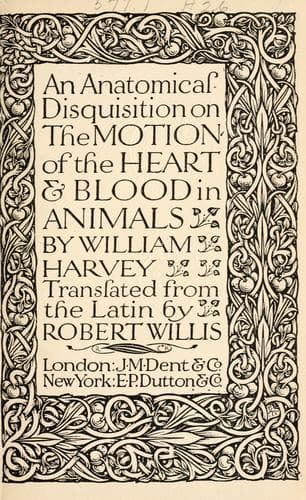
An anatomical disquisition on the motion of the heart & blood in animalsHarvey, William
Science
An anatomical disquisition on the motion of the heart & blood in animals
Harvey, William
Blood -- Circulation
How difficult is it to teach those who have no experience, the things
of which they have not any knowledge by their senses! And how useless
and intractable, and unimpregnable to true science are such auditors!
They show the judgment of the blind in regard to colours, of the deaf
in reference to concords. Who ever pretended to teach the ebb and flow
of the tide, or from a diagram to demonstrate the measurements of the
angles and the proportions of the sides of a triangle to a blind man,
or to one who had never seen the sea nor a diagram? He who is not
conversant with anatomy, inasmuch as he forms no conception of the
subject from the evidence of his own eyes, is virtually blind to all
that concerns anatomy, and unfit to appreciate what is founded thereon;
he knows nothing of that which occupies the attention of the anatomist,
nor of the principles inherent in the nature of the things which guide
him in his reasonings; facts and inferences as well as their sources
are alike unknown to such a one. But no kind of science can possibly
flow, save from some pre-existing knowledge of more obvious things;
and this is one main reason why our science in regard to the nature
of celestial bodies, is so uncertain and conjectural. I would ask of
those who profess a knowledge of the causes of all things, why the
two eyes keep constantly moving together, up or down, to this side or
to that, and not independently, one looking this way, another that;
why the two auricles of the heart contract simultaneously, and the
like? Are fevers, pestilence, and the wonderful properties of various
medicines to be denied because their causes are unknown? Who can tell
us why the fœtus in utero, breathing no air up to the tenth month of
its existence, is yet not suffocated? Born in the course of the seventh
or eighth month, and having once breathed, it is nevertheless speedily
suffocated if its respiration be interrupted. Why can the fœtus still
contained within the uterus, or enveloped in the membranes, live
without respiration; whilst once exposed to the air, unless it breathes
it inevitably dies?[52]
[52] Vide Chapter VI. of the Disq. on the Motion of the Heart and
Blood.
Public-domain text, read in full here on John Shaqi.
Reviews
Reviews
No reviews yet
Be the first to share your thoughts on this work.
Elsewhere in the archive
Join the Discussion
Join the discussion
Sign in to leave a comment or review.
Sign InorCreate an account