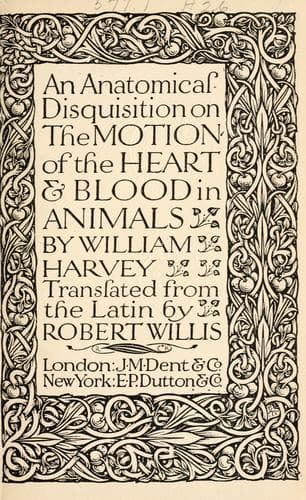
An anatomical disquisition on the motion of the heart & blood in animalsHarvey, William
Science
An anatomical disquisition on the motion of the heart & blood in animals
Harvey, William
Blood -- Circulation
Observing that many hesitate to acknowledge the circulation, and others
oppose it, because, as I conceive, they have not rightly understood
me, I shall here recapitulate briefly what I have said in my work on
the Motion of the Heart and Blood. The blood contained in the veins,
in its magazine, and where it is collected in largest quantity, viz.
in the vena cava, close to the base of the heart and right auricle,
gradually increasing in temperature by its internal heat, and becoming
attenuated, swells and rises like bodies in a state of fermentation,
whereby the auricle being dilated, and then contracting, in virtue
of its pulsative power, forthwith delivers its charge into the right
ventricle; which being filled, and the systole ensuing, the charge,
hindered from returning into the auricle by the tricuspid valves, is
forced into the pulmonary artery, which stands open to receive it,
and is immediately distended with it. Once in the pulmonary artery,
the blood cannot return, by reason of the sigmoid valves; and then
the lungs, alternately expanded and contracted during inspiration and
expiration, afford it passage by the proper vessels into the pulmonary
veins; from the pulmonary veins, the left auricle, acting equally and
synchronously with the right auricle, delivers the blood into the left
ventricle; which acting harmoniously with the right ventricle, and all
regress being prevented by the mitral valves, the blood is projected
into the aorta, and consequently impelled into all the arteries of
the body. The arteries, filled by this sudden push, as they cannot
discharge themselves so speedily, are distended; they receive a shock,
or undergo their diastole. But as this process goes on incessantly, I
infer that the arteries both of the lungs and of the body at large,
under the influence of such a multitude of strokes of the heart and
injections of blood, would finally become so over-gorged and distended,
that either any further injection must cease, or the vessels would
burst, or the whole blood in the body would accumulate within them,
were there not an exit provided for it.
The same reasoning is applicable to the ventricles of the heart:
distended by the ceaseless action of the auricles, did they not
disburthen themselves by the channels of the arteries, they would by
and by become over-gorged, and be fixed and made incapable of all
motion. Now this, my conclusion, is true and necessary, if my premises
be true; but that these are either true or false, our senses must
inform us, not our reason--ocular inspection, not any process of the
mind.
Public-domain text, read in full here on John Shaqi.
Reviews
Reviews
No reviews yet
Be the first to share your thoughts on this work.
Elsewhere in the archive
Join the Discussion
Join the discussion
Sign in to leave a comment or review.
Sign InorCreate an account