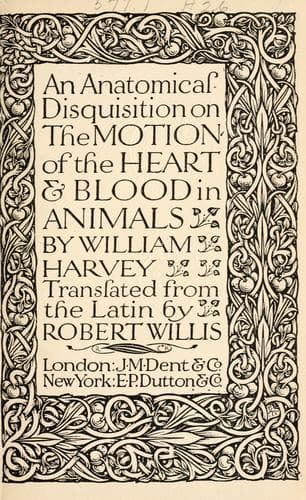
An anatomical disquisition on the motion of the heart & blood in animalsHarvey, William
Science
An anatomical disquisition on the motion of the heart & blood in animals
Harvey, William
Blood -- Circulation
An artery denuded and divided in the way I have indicated, sustains no
shock, and therefore does not pulsate; whence it clearly appears that
the arteries have no inherent pulsative power, and that neither do
they derive any from the heart; but that they undergo their diastole
solely from the impulse of the blood; for in the full stream, flowing
to a distance, you may see the systole and diastole, all the motions
of the heart--their order, force, rhythm, &c.,[54] as it were in a
mirror, and even perceive them by the touch. Precisely as in the water
that is forced aloft, through a leaden pipe, by working the piston
of a forcing-pump, each stroke of which, though the jet be many feet
distant, is nevertheless distinctly perceptible,--the beginning,
increasing strength, and end of the impulse, as well as its amount,
and the regularity or irregularity with which it is given, being
indicated, the same precisely is the case from the orifice of a divided
artery; whence, as in the instance of the forcing engine quoted, you
will perceive that the efflux is uninterrupted, although the jet is
alternately greater and less. In the arteries, therefore, besides the
concussion or impulse of the blood, the pulse or beat of the artery,
which is not equally exhibited in all, there is a perpetual flow and
motion of the blood, which returns in an unbroken stream to the point
from whence it commenced--the right auricle of the heart.
[54] Vide Chapter III, on the Motion of the Heart and Blood.
All these points you may satisfy yourself upon, by exposing one of the
longer arteries, and having taken it between your finger and thumb,
dividing it on the side remote from the heart. By the greater or less
pressure of your fingers, you can have the vessel pulsating less or
more, or losing the pulse entirely, and recovering it at will. And
as these things proceed thus when the chest is uninjured, so also do
they go on for a short time when the thorax is laid open, and the
lungs having collapsed, all the respiratory motions have ceased; here,
nevertheless, for a little while you may perceive the left auricle
contracting and emptying itself, and becoming whiter; but by and by
growing weaker and weaker, it begins to intermit, as does the left
ventricle also, and then it ceases to beat altogether, and becomes
quiescent. Along with this, and in the same measure, does the stream
of blood from the divided artery grow less and less, the pulse of the
vessel weaker and weaker, until at last, the supply of blood and the
impulse of the left ventricle failing, nothing escapes from it. You
may perform the same experiment, tying the pulmonary veins, and so
taking away the pulse of the left auricle, or relaxing the ligature,
and restoring it at pleasure. In this experiment, too, you will observe
what happens in moribund animals--viz. that the left ventricle first
ceases from pulsation and motion, then the left auricle, next the right
Public-domain text, read in full here on John Shaqi.
Reviews
Reviews
No reviews yet
Be the first to share your thoughts on this work.
Elsewhere in the archive
Join the Discussion
Join the discussion
Sign in to leave a comment or review.
Sign InorCreate an account