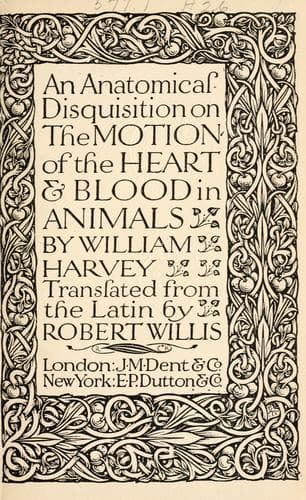
An anatomical disquisition on the motion of the heart & blood in animalsHarvey, William
Science
An anatomical disquisition on the motion of the heart & blood in animals
Harvey, William
Blood -- Circulation
I maintain further, that the blood in the veins always and everywhere
flows from less to greater branches, and from every part towards
the heart; whence I gather that the whole charge which the arteries
receive, and which is incessantly thrown into them, is delivered to the
veins, and flows back by them to the source whence it came. In this
way, indeed, is the circulation of the blood established: by an efflux
and reflux from and to the heart; the fluid being forcibly projected
into the arterial system, and then absorbed and imbibed from every
part by the veins, it returns through these in a continuous stream.
That all this is so, sense assures us; and necessary inference from the
perceptions of sense takes away all occasion for doubt. Lastly, this is
what I have striven, by my observations and experiments, to illustrate
and make known; I have not endeavoured from causes and probable
principles to demonstrate my propositions, but, as of higher authority,
to establish them by appeals to sense and experiment, after the manner
of anatomists.
And here I would refer to the amount of force, even of violence, which
sight and touch make us aware of in the heart and greater arteries;
and to the systole and diastole constituting the pulse in the large
warm-blooded animals, which I do not say is equal in all the vessels
containing blood, nor in all animals that have blood; but which is of
such a nature and amount in all, that a flow and rapid passage of the
blood through the smaller arteries, the interstices of the tissues, and
the branches of the veins, must of necessity take place; and therefore
there is a circulation.
For neither do the most minute arteries, nor the veins, pulsate; but
the larger arteries and those near the heart pulsate, because they
do not transmit the blood so quickly as they receive it.[53] Having
exposed an artery, and divided it so that the blood shall flow out as
fast and freely as it is received, you will scarcely perceive any pulse
in that vessel; and for the simple reason, that an open passage being
afforded, the blood escapes, merely passing through the vessel, not
distending it. In fishes, serpents, and the colder animals, the heart
beats so slowly and feebly, that a pulse can scarcely be perceived in
the arteries; the blood in them is transmitted gradually. Whence in
them, as also in the smaller branches of the arteries in man, there is
no distinction between the coats of the arteries and veins, because
the arteries have to sustain no shock from the impulse of the blood.
[53] Vide Chapter III, on the Motion of the Heart and Blood.
Public-domain text, read in full here on John Shaqi.
Reviews
Reviews
No reviews yet
Be the first to share your thoughts on this work.
Elsewhere in the archive
Join the Discussion
Join the discussion
Sign in to leave a comment or review.
Sign InorCreate an account