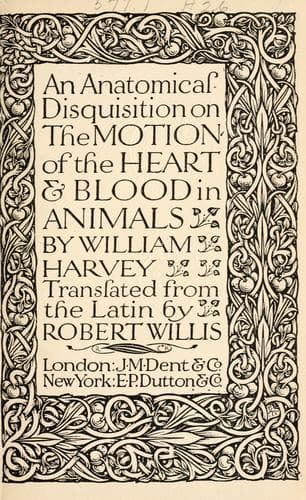
An anatomical disquisition on the motion of the heart & blood in animalsHarvey, William
Science
An anatomical disquisition on the motion of the heart & blood in animals
Harvey, William
Blood -- Circulation
Since, then, I find a transit from the arteries into the veins in
the three places which I have above mentioned, equivalent to the
anastomoses of the ancients, and even affording the farther security
against any regurgitation into the arteries of the blood once delivered
to the veins, and as a mechanism of such a kind is more elaborate and
better suited to the circulation of the blood, I have therefore thought
that the anastomoses imagined by the ancients were to be rejected.
But you will ask, what is this artifice? what these ducts? viz. the
small arteries, which are always much smaller--twice, even three times
smaller--than the veins which they accompany, which they approach
continually more and more, and within the tunics of which they are
finally lost. I have been therefore led to conceive that the blood
brought thus between the coats of the veins advanced for a certain way
along them, and that the same thing took place here which we observe in
the conjunction between the ureters and the bladder, and of the biliary
duct with the duodenum. The ureters insinuate themselves obliquely and
tortuously between the coats of the bladder, without anything in the
nature of an anastomosis, yet in such a manner as occasionally affords
a passage to blood, to pus, and to calculi; it is easy, moreover, to
fill the bladder through them with air or water; but by no effort can
you force anything from the bladder into them. I care not, however,
to make any question here of the etymology of words; for I am not
of opinion that it is the province of philosophy to infer aught as
to the works of nature from the signification of words, or to cite
anatomical disquisitions before the grammatical tribunal. Our business
is not so much to inquire what a word properly signifies, as how it is
commonly understood; for use and wont, as in so many other matters,
are greatly to be considered in the interpretation of words. It seems
to me, therefore, that we are to take especial care not to employ any
unusual words, or any common ones already familiarly used, in a sense
which is not in accordance with the meaning we purpose to attach to
them. You indeed counsel well when you say, “only make sure of the
thing, call it what you will.” But when we discover that a thing has
hitherto been indifferently or incorrectly explained (as the sequel
will show it to have been in the present case), I do not think that
the old appellation can ever be well applied to the new fact; by using
the old term you are apt to mislead where you desire to instruct. I
acknowledge, then, a transit of the blood from the arteries into the
veins, and that occasionally immediate, without any intervention of
soft parts; but it does not take place in the manner hitherto believed,
and as you yourself would have it, where you say that anastomoses,
correctly speaking, rather than an anastomosis, were required, namely,
that the vessels may be open on either hand, and give free passage to
Public-domain text, read in full here on John Shaqi.
Reviews
Reviews
No reviews yet
Be the first to share your thoughts on this work.
Elsewhere in the archive
Join the Discussion
Join the discussion
Sign in to leave a comment or review.
Sign InorCreate an account