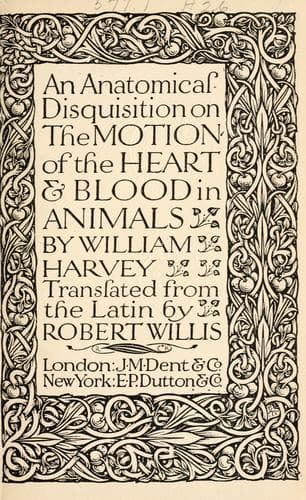
An anatomical disquisition on the motion of the heart & blood in animalsHarvey, William
Science
An anatomical disquisition on the motion of the heart & blood in animals
Harvey, William
Blood -- Circulation
the blood hither and thither. And hence it comes that you fail in the
right solution of the question, when you ask how it happens that with
the arteries as patent or pervious as the veins, the blood nevertheless
flows only from the former into the latter, never from the latter into
the former? For what you say of the impulse of the blood through the
arteries does not fully solve the difficulty in the present instance.
For if the aorta be tied near the left ventricle of the heart in
a living animal, and all the blood removed from the arteries, the
veins are still seen full of blood; so that it neither moves back
spontaneously into the arteries, nor can it be repelled into these by
any force, whilst even in a dead animal it nevertheless falls of its
own accord through the finest pores of the flesh and skin from superior
into inferior parts. The passage of the blood into the veins is,
indeed, effected by the impulse in question, and not by any dilatation
of these in the manner of bellows, by which the blood is drawn towards
them; but there are no anastomoses of the vessels by conjunction (per
copulam), in the way you mention, none where two vessels meeting are
conjoined by equal mouths. There is only an opening of the artery into
the vein, exactly in the same manner as the ureter opens into the
bladder (and the biliary duct opens into the jejunum), by which, whilst
the flow of urine is perfectly free towards the bladder, all reflux
into the smaller conduits is effectually prevented; the fuller the
bladder is, indeed, the more are the sides of the ureters compressed,
and the more effectual is all ascent of urine in them prevented. Now,
on this hypothesis, it is easy to render a reason for the experiment
which I have already mentioned. I add further, that I can in nowise
admit such anastomoses as are commonly imagined, inasmuch as the
arteries being always much smaller than the veins, it is impossible
that their sides can mutually conjoin in such a way as will allow of
their forming a common meatus; it seems matter of necessity that things
which join in this way should be of equal size. Lastly, these vessels
having made a certain circuit, must, at their terminations, encounter
one another; they would not, as it happens, proceed straight to the
extremities of the body. And the veins, on their part, if they were
conjoined with the arteries by mutual inosculations, would necessarily,
and by reason of the continuity of parts, pulsate like the arteries.
Public-domain text, read in full here on John Shaqi.
Reviews
Reviews
No reviews yet
Be the first to share your thoughts on this work.
Elsewhere in the archive
Join the Discussion
Join the discussion
Sign in to leave a comment or review.
Sign InorCreate an account