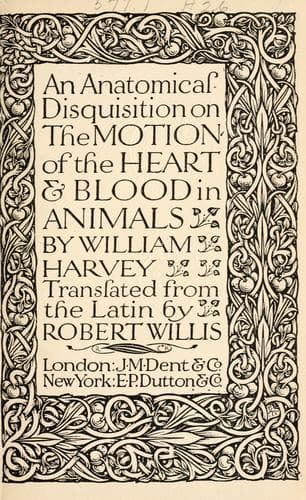
An anatomical disquisition on the motion of the heart & blood in animalsHarvey, William
Science
An anatomical disquisition on the motion of the heart & blood in animals
Harvey, William
Blood -- Circulation
ILLUSTRIOUS SIR,--The reason why your most kind letter has remained up
to this time unanswered is simply this, that the book of M. Pecquet,
upon which you ask my opinion, did not come into my hands until towards
the end of the past month. It stuck by the way, I imagine, with some
one, who, either through negligence, or desiring himself to see what
was newest, has for so long a time hindered me of the pleasure I have
had in the perusal. That you may, therefore, at once and clearly know
my opinion of this work, I say that I greatly commend the author for
his assiduity in dissection, for his dexterity in contriving new
experiments, and for the shrewdness which he still evinces in his
remarks upon them. With what labour do we attain to the hidden things
of truth when we take the averments of our senses as the guide which
God has given us for attaining to a knowledge of his works; avoiding
that specious path on which the eyesight is dazzled with the brilliancy
of mere reasoning, and so many are led to wrong conclusions, to
probabilities only, and too frequently to sophistical conjectures on
things!
I further congratulate myself on his confirmation of my views of the
circulation of the blood by such lucid experiments and clear reasons.
I only wish he had observed that the heart has three kinds of motion,
namely, the systole, in which the organ contracts and expels the blood
contained in its cavities, and next, a movement, the opposite of the
former one, in which the fibres of the heart appropriated to motion are
relaxed. Now these two motions inhere in the substance of the heart
itself, just as they do in all other muscles. The remaining motion is
the diastole, in which the heart is distended by the blood impelled
from the auricles into the ventricles; and the ventricles, thus replete
and distended, are stimulated to contraction, and this motion always
precedes the systole, which follows immediately afterwards.
Public-domain text, read in full here on John Shaqi.
Reviews
Reviews
No reviews yet
Be the first to share your thoughts on this work.
Elsewhere in the archive
Join the Discussion
Join the discussion
Sign in to leave a comment or review.
Sign InorCreate an account