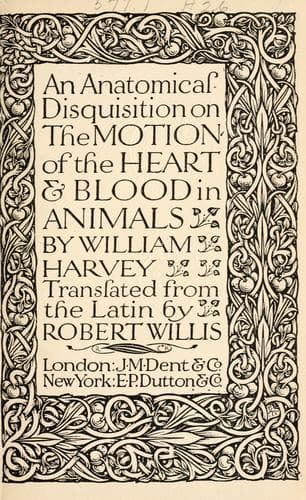
An anatomical disquisition on the motion of the heart & blood in animalsHarvey, William
Science
An anatomical disquisition on the motion of the heart & blood in animals
Harvey, William
Blood -- Circulation
With regard to the lacteal veins discovered by Aselli, and by the
further diligence of Pecquet, who discovered the receptacle or
reservoir of the chyle, and traced the canals thence to the subclavian
veins, I shall tell you freely, since you ask me what I think of them.
I had already, in the course of my dissections, I venture to say
even before Aselli had published his book,[57] observed these white
canals, and plenty of milk in various parts of the body, especially
in the glands of younger animals, as in the mesentery, where glands
abound; and thence I thought came the pleasant taste of the thymus in
the calf and lamb, which, as you know, is called the sweetbread in
our vernacular tongue. But for various reasons, and led by several
experiments, I could never be brought to believe that that milky fluid
was chyle conducted hither from the intestines, and distributed to
all parts of the body for their nourishment; but that it was rather
met with occasionally and by accident, and proceeded from too ample a
supply of nourishment and a peculiar vigour of concoction; in virtue
of the same law of nature, in short, as that by which fat, marrow,
semen, hair, &c., are produced; even as in the due digestion of ulcers
pus is formed, which the nearer it approaches to the consistency of
milk, viz. as it is whiter, smoother, and more homogeneous, is held
more laudable, so that some of the ancients thought pus and milk were
of the same nature, or nearly allied. Wherefore, although there can be
no question of the existence of the vessels themselves, still I can by
no means agree with Aselli in considering them as chyliferous vessels,
and this especially for the reasons about to be given, which lead me
to a different conclusion. For the fluid contained in the lacteal
veins appears to me to be pure milk, such as is found in the lacteal
veins [the milk ducts] of the mammæ. Now it does not seem to me very
probable (any more than it does to Auzotius in his letter to Pecquet)
that the milk is chyle, and thus that the whole body is nourished
by means of milk. The reasons which lead to a contrary conclusion,
viz. that it is chyle, are not of such force as to compel my assent.
I should first desire to have it demonstrated to me by the clearest
reasonings, and the guarantee of experiments, that the fluid contained
in these vessels was chyle, which, brought hither from the intestines,
supplies nourishment to the whole body. For unless we are agreed upon
the first point, any ulterior, any more operose, discussion of their
nature, is in vain. But how can these vessels serve as conduits for the
whole of the chyle, or the nourishment of the body, when we see that
they are different in different animals? In some they proceed to the
liver, in others to the porta only, and in others still to neither of
these. In some creatures they are seen to be extremely numerous in the
pancreas; in others the thymus is crowded with them; in a third class,
Public-domain text, read in full here on John Shaqi.
Reviews
Reviews
No reviews yet
Be the first to share your thoughts on this work.
Elsewhere in the archive
Join the Discussion
Join the discussion
Sign in to leave a comment or review.
Sign InorCreate an account