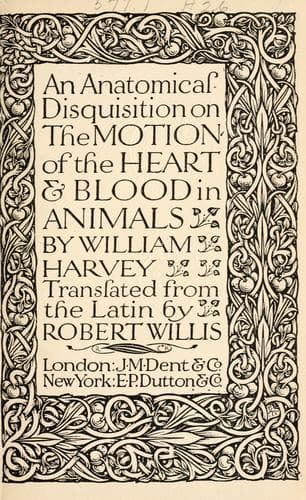
An anatomical disquisition on the motion of the heart & blood in animalsHarvey, William
Science
An anatomical disquisition on the motion of the heart & blood in animals
Harvey, William
Blood -- Circulation
I add, too, that the chyle is neither in all animals, nor at all
times, of the consistency and colour of milk; and therefore did these
vessels carry chyle, they could not always (which nevertheless they
do) contain a white fluid in their interior, but would sometimes be
coloured yellow, green, or of some other hue (in the same way as the
urine is affected, and acquires different colours from eating rhubarb,
asparagus, figs, &c.); or otherwise, when large quantities of mineral
water were drunk, they would be deprived of almost all colour. Besides,
did that white matter pass from the intestines into those canals, or
were it attracted from the intestines, the same fluid ought certainly
to be discovered somewhere within the intestines themselves, or in
their spongy tunics; for it does not seem probable that any fluid by
bare and rapid percolation of the intestines could assume a new nature,
and be changed into milk. Moreover, were the chyle only filtered
through the tunics of the intestines, it ought surely to retain some
traces of its original nature, and resemble in colour and smell the
fluid contained in the intestines; it ought to smell offensively at
least; for whatever is contained in the intestines is tinged with bile,
and smells unpleasantly. Some have consequently thought that the body
was nourished by means of chyle raised into attenuated vapour, because
vapours exhaling in the alembic, even from fœtid matters, often do not
smell amiss.
The learned Pecquet ascribes the motion of this milky fluid to
respiration. For my own part, though strongly tempted to do otherwise,
I shall say nothing upon this topic until we are agreed as to what
the fluid is. But were we to concede the point (which Pecquet takes
for granted without any sufficient reason in the shape of argument),
that chyle was continually transported by the canals in question from
the intestines to the subclavian veins, in which the vessels he has
lately discovered terminate, we should have to say that the chyle
before reaching the heart was mixed with the blood which is about
to enter the right side of the organ, and that it there obtains a
further concoction. But what, some one might with as good reason ask,
should hinder it from passing into the porta, then into the liver,
and thence into the cava, in conformity with the arrangement which
Aselli and others are said to have found? Why, indeed, should we not
as well believe that the chyle enters the mouths of the mesenteric
veins, and in this way becomes immediately mingled with the blood,
where it might receive digestion and perfection from the heat, and
serve for the nutrition of all the parts? For the heart itself can be
accounted of higher importance than other parts, can be termed the
source of heat and of life, upon no other grounds than as it contains
a larger quantity of blood in its cavities, where, as Aristotle says,
the blood is not contained in veins as it is in other parts, but in
Public-domain text, read in full here on John Shaqi.
Reviews
Reviews
No reviews yet
Be the first to share your thoughts on this work.
Elsewhere in the archive
Join the Discussion
Join the discussion
Sign in to leave a comment or review.
Sign InorCreate an account