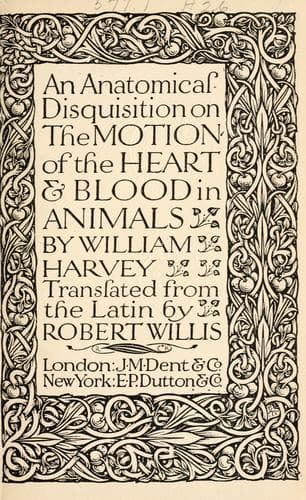
An anatomical disquisition on the motion of the heart & blood in animalsHarvey, William
Science
An anatomical disquisition on the motion of the heart & blood in animals
Harvey, William
Blood -- Circulation
an ample sinus and cistern, as it were. And that the thing is so in
fact, I find an argument in the distribution of innumerable arteries
and veins to the intestines, more than to any other part of the body,
in the same way as the uterus abounds with blood-vessels during the
period of pregnancy. For nature never acts inconsiderately. In all
the red-blooded animals, consequently, which require [abundant]
nourishment, we find a copious distribution of mesenteric vessels;
but lacteal veins we discover in but a few, and even in these not
constantly. Wherefore, if we are to judge of the uses of parts as we
meet with them in general and in the greater number of animals, beyond
all doubt those filaments of a white colour, and very like the fibres
of a spider’s web, are not instituted for the purpose of transporting
nourishment, neither is the fluid they contain to be designated by the
name of chyle; the mesenteric vessels are rather destined to the duty
in question. Because, of that whence an animal is constituted, by that
must it necessarily grow, and by that consequently be nourished; for
the nutritive and augmentative faculties, or nutrition and growth,
are essentially the same. An animal, therefore, naturally grows in the
same manner as it receives immediate nutriment from the first. Now it
is a most certain fact (as I have shown elsewhere) that the embryos
of all red-blooded animals are nourished by means of the umbilical
vessels from the mother, and this in virtue of the circulation of the
blood. They are not nourished, however, immediately by the blood, as
many have imagined, but after the manner of the chick in ovo, which
is first nourished by the albumen, and then by the vitellus, which
is finally drawn into and included within the abdomen of the chick.
All the umbilical vessels, however, are inserted into the liver, or
at all events pass through it, even in those animals whose umbilical
vessels enter the vena portæ, as in the chick, in which the vessels
proceeding from the yelk always so terminate. In the selfsame way,
therefore, as the chick is nourished from a nutriment, (viz. the
albumen and vitellus,) previously prepared, even so does it continue
to be nourished through the whole course of its independent existence.
And the same thing, as I have elsewhere shown, is common to all embryos
whatsoever: the nourishment, mingled with the blood, is transmitted
through their veins to the heart, whence moving on by the arteries,
it is carried to every part of the body. The fœtus when born, when
thrown upon its own resources, and no longer immediately nourished by
the mother, makes use of its stomach and intestines just as the chick
makes use of the contents of the egg, and vegetables make use of the
ground whence they derive concocted nutriment. For even as the chick
at the commencement obtained its nourishment from the egg, by means of
the umbilical vessels (arteries and veins) and the circulation of the
Public-domain text, read in full here on John Shaqi.
Reviews
Reviews
No reviews yet
Be the first to share your thoughts on this work.
Elsewhere in the archive
Join the Discussion
Join the discussion
Sign in to leave a comment or review.
Sign InorCreate an account