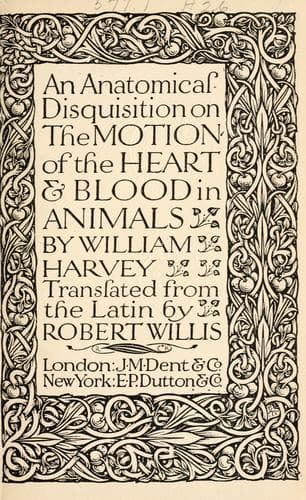
An anatomical disquisition on the motion of the heart & blood in animals — John Shaqi
An anatomical disquisition on the motion of the heart & blood in animalsHarvey, William
Science
An anatomical disquisition on the motion of the heart & blood in animals
Harvey, William
Blood -- Circulation
However much the renewal of classical learning in the fourteenth,
fifteenth, and sixteenth centuries may have furthered the development
of letters and of art, it had anything but a favourable influence on
the progress of science. The interest awakened in the literature of
Greece and Rome was shown in admiration not only for the works of
poets, historians, and orators, but also for those of physicians,
anatomists, and astronomers. In consequence scientific investigation
was almost wholly restricted to the study of the writings of authors
like Aristotle, Hippocrates, Ptolemy, and Galen, and it became the
highest ambition to explain and comment upon their teachings, almost
an impiety to question them. Independent inquiry, the direct appeal
to nature, were thus discouraged, and indeed looked upon with the
utmost distrust if their results ran counter to what was found in
the works of Aristotle or Galen. This spell of ancient authority was
broken by the anatomists of the sixteenth century, who determined at
all costs to examine the human body for themselves, and to be guided
by what their own observations revealed to them; and it was finally
overcome by the independent genius of two men working in very different
scientific spheres, Galileo and Harvey. These illustrious observers
were contemporaries during the greater part of their lives, and were
some years together at the famous University of Padua. Galileo and
Harvey refused to be bound by the teachings of Aristotle and Galen, and
appealed from these authorities to the actual facts of nature which any
man could observe for himself. Their scientific work is therefore of
interest, not only for the innate value of the discoveries they made,
but also because it shows them as pioneers in that independent spirit
of scientific inquiry to which the great advance in natural knowledge
since their time is so largely due.
Harvey’s work, by which his name has been made immortal, strikingly
illustrates this. He was the first to show the nature of the movements
of the heart, and how the blood moved in the body. He did so by putting
on one side authority, and directly appealing to observation and
experiment. The completeness of the success with which this independent
line was taken, as exemplified in his treatise “On the Movement of the
Heart and Blood,” is such as to excite the admiration of every modern
physiologist. “C’est un chef-d’œuvre,” says a distinguished French
physiologist, Flourens, “ce petit livre de cent pages est le plus beau
livre de la physiologie.”[1]
[1] Flourens, Histoire de la Découvert de la Circulation du Sang,
1854.
Public-domain text, read in full here on John Shaqi.
Reviews
Reviews
No reviews yet
Be the first to share your thoughts on this work.
Join the Discussion
Join the discussion
Sign in to leave a comment or review.
Sign InorCreate an account