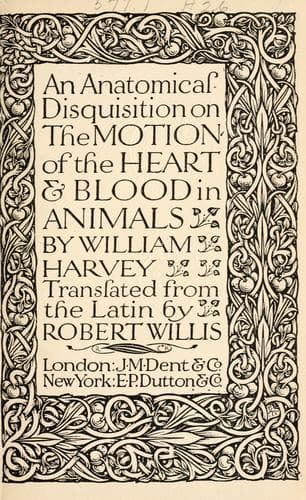
An anatomical disquisition on the motion of the heart & blood in animalsHarvey, William
Science
An anatomical disquisition on the motion of the heart & blood in animals
Harvey, William
Blood -- Circulation
systole of their arteries through the infinite mass of waters? For to
say that they absorb the air that is infixed in the water, and emit
their fumes into this medium, were to utter something very like a mere
figment. And if the arteries in their systole expel fuliginous vapours
from their cavities through the pores of the flesh and skin, why not
the spirits, which are said to be contained in these vessels, at the
same time, since spirits are much more subtile than fuliginous vapours
or smoke? And further, if the arteries take in and cast out air in the
systole and diastole, like the lungs in the process of respiration,
wherefore do they not do the same thing when a wound is made in one of
them, as is done in the operation of arteriotomy? When the windpipe is
divided, it is sufficiently obvious that the air enters and returns
through the wound by two opposite movements; but when an artery is
divided, it is equally manifest that blood escapes in one continuous
stream, and that no air either enters or issues. If the pulsations
of the arteries fan and refrigerate the several parts of the body as
the lungs do the heart, how comes it, as is commonly said, that the
arteries carry the vital blood into the different parts, abundantly
charged with vital spirits, which cherish the heat of these parts,
sustain them when asleep, and recruit them when exhausted? and how
should it happen that, if you tie the arteries, immediately the parts
not only become torpid, and frigid, and look pale, but at length cease
even to be nourished? This, according to Galen, is because they are
deprived of the heat which flowed through all parts from the heart,
as its source; whence it would appear that the arteries rather carry
warmth to the parts than serve for any fanning or refrigeration.
Besides, how can the diastole [of the arteries] draw spirits from the
heart to warm the body and its parts, and, from without, means of
cooling or tempering them? Still further, although some affirm that
the lungs, arteries, and heart have all the same offices, they yet
maintain that the heart is the workshop of the spirits, and that the
arteries contain and transmit them; denying, however, in opposition
to the opinion of Columbus, that the lungs can either make or contain
spirits; and then they assert, with Galen, against Erasistratus, that
it is blood, not spirits, which is contained in the arteries.
Public-domain text, read in full here on John Shaqi.
Reviews
Reviews
No reviews yet
Be the first to share your thoughts on this work.
Join the Discussion
Join the discussion
Sign in to leave a comment or review.
Sign InorCreate an account