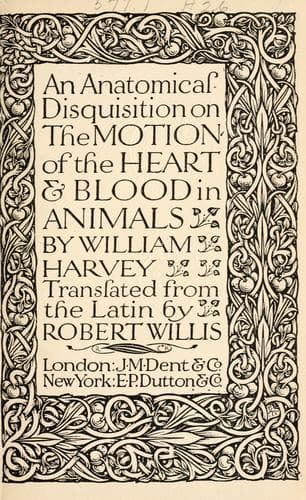
An anatomical disquisition on the motion of the heart & blood in animalsHarvey, William
Science
An anatomical disquisition on the motion of the heart & blood in animals
Harvey, William
Blood -- Circulation
For never yet has any one attained
To such perfection, but that time, and place,
And use, have brought addition to his knowledge;
Or made correction, or admonished him,
That he was ignorant of much which he
Had thought he knew; or led him to reject
What he had once esteemed of highest price.
So will it, perchance, be found with reference to the heart at this
time; or others, at least, starting from hence, the way pointed out
to them, advancing under the guidance of a happier genius, may make
occasion to proceed more fortunately, and to inquire more accurately.
CHAPTER II
OF THE MOTIONS OF THE HEART, AS SEEN IN THE DISSECTION OF LIVING ANIMALS
In the first place, then, when the chest of a living animal is laid
open and the capsule that immediately surrounds the heart is slit up or
removed, the organ is seen now to move, now to be at rest;--there is a
time when it moves, and a time when it is motionless.
These things are more obvious in the colder animals, such as toads,
frogs, serpents, small fishes, crabs, shrimps, snails, and shell-fish.
They also become more distinct in warm-blooded animals, such as the dog
and hog, if they be attentively noted when the heart begins to flag, to
move more slowly, and, as it were, to die: the movements then become
slower and rarer, the pauses longer, by which it is made much more
easy to perceive and unravel what the motions really are, and how they
are performed. In the pause, as in death, the heart is soft, flaccid,
exhausted, lying, as it were, at rest.
In the motion, and interval in which this is accomplished, three
principal circumstances are to be noted:
1. That the heart is erected, and rises upwards to a point, so that
at this time it strikes against the breast and the pulse is felt
externally.
2. That it is everywhere contracted, but more especially towards
the sides, so that it looks narrower, relatively longer, more drawn
together. The heart of an eel taken out of the body of the animal and
placed upon the table or the hand, shows these particulars; but the
same things are manifest in the heart of small fishes and of those
colder animals where the organ is more conical or elongated.
3. The heart being grasped in the hand, is felt to become harder during
its action. Now this hardness proceeds from tension, precisely as when
the forearm is grasped, its tendons are perceived to become tense and
resilient when the fingers are moved.
4. It may further be observed in fishes, and the colder blooded
animals, such as frogs, serpents, &c., that the heart, when it moves,
becomes of a paler colour, when quiescent of a deeper blood-red colour.
Public-domain text, read in full here on John Shaqi.
Reviews
Reviews
No reviews yet
Be the first to share your thoughts on this work.
Join the Discussion
Join the discussion
Sign in to leave a comment or review.
Sign InorCreate an account