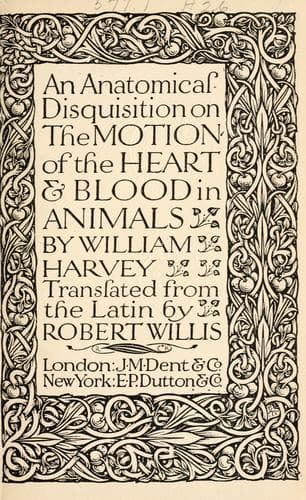
An anatomical disquisition on the motion of the heart & blood in animalsHarvey, William
Science
An anatomical disquisition on the motion of the heart & blood in animals
Harvey, William
Blood -- Circulation
Neither is it by any means to be allowed that the heart only moves
in the line of its straight fibres, although the great Vesalius,
giving this notion countenance, quotes a bundle of osiers bound into a
pyramidal heap in illustration; meaning, that as the apex is approached
to the base, so are the sides made to bulge out in the fashion of
arches, the cavities to dilate, the ventricles to acquire the form of a
cupping-glass and so to suck in the blood. But the true effect of every
one of its fibres is to constringe the heart at the same time that
they render it tense; and this rather with the effect of thickening
and amplifying the walls and substance of the organ than enlarging its
ventricles. And, again, as the fibres run from the apex to the base,
and draw the apex towards the base, they do not tend to make the walls
of the heart bulge out in circles, but rather the contrary; inasmuch
as every fibre that is circularly disposed, tends to become straight
when it contracts; and is distended laterally and thickened, as in the
case of muscular fibres in general, when they contract, that is, when
they are shortened longitudinally, as we see them in the bellies of
the muscles of the body at large. To all this, let it be added, that
not only are the ventricles contracted in virtue of the direction
and condensation of their walls, but farther, that those fibres, or
bands, styled nerves by Aristotle, which are so conspicuous in the
ventricles of the larger animals, and contain all the straight fibres,
(the parietes of the heart containing only circular ones,) when they
contract simultaneously, by an admirable adjustment all the internal
surfaces are drawn together, as if with cords, and so is the charge of
blood expelled with force.
Neither is it true, as vulgarly believed, that the heart by any
dilatation or motion of its own has the power of drawing the blood
into the ventricles; for when it acts and becomes tense, the blood is
expelled; when it relaxes and sinks together it receives the blood in
the manner and wise which will by and by be explained.
CHAPTER III
OF THE MOTIONS OF ARTERIES, AS SEEN IN THE DISSECTION OF LIVING ANIMALS
In connection with the motions of the heart these things are further to
be observed having reference to the motions and pulses of the arteries:
1. At the moment the heart contracts, and when the breast is struck,
when in short the organ is in its state of systole, the arteries are
dilated, yield a pulse, and are in the state of diastole. In like
manner, when the right ventricle contracts and propels its charge of
blood, the arterial vein [the pulmonary artery] is distended at the
same time with the other arteries of the body.
Public-domain text, read in full here on John Shaqi.
Reviews
Reviews
No reviews yet
Be the first to share your thoughts on this work.
Join the Discussion
Join the discussion
Sign in to leave a comment or review.
Sign InorCreate an account