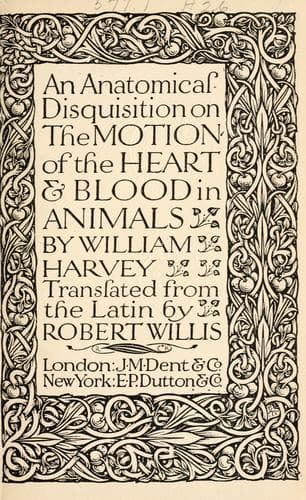
An anatomical disquisition on the motion of the heart & blood in animals — John Shaqi
An anatomical disquisition on the motion of the heart & blood in animalsHarvey, William
Science
An anatomical disquisition on the motion of the heart & blood in animals
Harvey, William
Blood -- Circulation
Besides this, however, I have occasionally observed, after the heart
and even its right auricle had ceased pulsating,--when it was in
articulo mortis in short,--that an obscure motion, an undulation or
palpitation, remained in the blood itself, which was contained in the
right auricle, this being apparent so long as it was imbued with heat
and spirit. And indeed a circumstance of the same kind is extremely
manifest in the course of the generation of animals, as may be seen in
the course of the first seven days of the incubation of the chick: A
drop of blood makes its appearance which palpitates, as Aristotle had
already observed; from this, when the growth is further advanced and
the chick is fashioned, the auricles of the heart are formed, which
pulsating henceforth give constant signs of life. When at length, and
after the lapse of a few days, the outline of the body begins to be
distinguished, then is the ventricular part of the heart also produced;
but it continues for a time white and apparently bloodless, like the
rest of the animal; neither does it pulsate or give signs of motion. I
have seen a similar condition of the heart in the human foetus about
the beginning of the third month, the heart being then whitish and
bloodless, although its auricles contained a considerable quantity of
purple blood. In the same way in the egg, when the chick was formed and
had increased in size, the heart too increased and acquired ventricles,
which then began to receive and to transmit blood.
And this leads me to remark, that he who inquires very particularly
into this matter will not conclude that the heart, as a whole, is
the primum vivens, ultimum moriens--the first part to live, the last
to die, but rather its auricles, or the part which corresponds to
the auricles in serpents, fishes, &c., which both lives before the
heart[23] and dies after it.
[23] [The reader will observe that Harvey, when he speaks of the
_heart_, always means the ventricles or ventricular portion of the
organ.]
Nay, has not the blood itself or spirit an obscure palpitation inherent
in it, which it has even appeared to me to retain after death? and it
seems very questionable whether or not we are to say that life begins
with the palpitation or beating of the heart. The seminal fluid of
all animals--the prolific spirit, as Aristotle observed, leaves their
body with a bound and like a living thing; and nature in death, as
Aristotle[24] further remarks, retracing her steps, reverts to whence
she had set out, returns at the end of her course to the goal whence
she had started; and as animal generation proceeds from that which is
not animal, entity from non-entity, so, by a retrograde course, entity,
by corruption, is resolved into non-entity; whence that in animals,
which was last created, fails first; and that which was first, fails
last.
[24] De Motu Animal. cap. 8.
Public-domain text, read in full here on John Shaqi.
Reviews
Reviews
No reviews yet
Be the first to share your thoughts on this work.
Join the Discussion
Join the discussion
Sign in to leave a comment or review.
Sign InorCreate an account