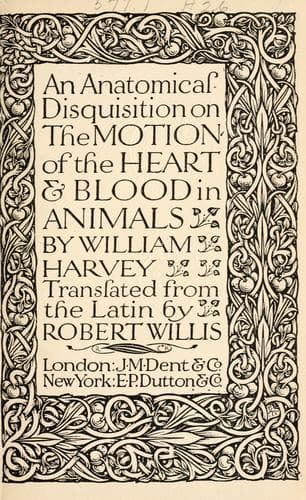
An anatomical disquisition on the motion of the heart & blood in animalsHarvey, William
Science
An anatomical disquisition on the motion of the heart & blood in animals
Harvey, William
Blood -- Circulation
Since the intimate connexion of the heart with the lungs, which
is apparent in the human subject, has been the probable cause of
the errors that have been committed on this point, they plainly do
amiss who, pretending to speak of the parts of animals generally, as
anatomists for the most part do, confine their researches to the human
body alone, and that when it is dead. They obviously act no otherwise
than he who, having studied the forms of a single commonwealth, should
set about the composition of a general system of polity; or who, having
taken cognizance of the nature of a single field, should imagine that
he had mastered the science of agriculture; or who, upon the ground of
one particular proposition, should proceed to draw general conclusions.
Had anatomists only been as conversant with the dissection of the lower
animals as they are with that of the human body, the matters that have
hitherto kept them in a perplexity of doubt would, in my opinion, have
met them freed from every kind of difficulty.
And, first, in fishes, in which the heart consists of but a single
ventricle, they having no lungs, the thing is sufficiently manifest.
Here the sac, which is situated at the base of the heart, and is the
part analogous to the auricle in man, plainly throws the blood into the
heart, and the heart, in its turn, conspicuously transmits it by a
pipe or artery, or vessel analogous to an artery; these are facts which
are confirmed by simple ocular inspection, as well as by a division of
the vessel, when the blood is seen to be projected by each pulsation of
the heart.
The same thing is also not difficult of demonstration in those animals
that have either no more, or, as it were, no more than a single
ventricle to the heart, such as toads, frogs, serpents, and lizards,
which, although they have lungs in a certain sense, as they have a
voice, (and I have many observations by me on the admirable structure
of the lungs of these animals, and matters appertaining, which,
however, I cannot introduce in this place,) still their anatomy plainly
shows that the blood is transferred in them from the veins to the
arteries in the same manner as in higher animals, viz. by the action
of the heart; the way, in fact, is patent, open, manifest; there is no
difficulty, no room for hesitating about it; for in them the matter
stands precisely as it would in man, were the septum of his heart
perforated or removed, or one ventricle made out of two; and this being
the case, I imagine that no one will doubt as to the way by which the
blood may pass from the veins into the arteries.
Public-domain text, read in full here on John Shaqi.
Reviews
Reviews
No reviews yet
Be the first to share your thoughts on this work.
Join the Discussion
Join the discussion
Sign in to leave a comment or review.
Sign InorCreate an account