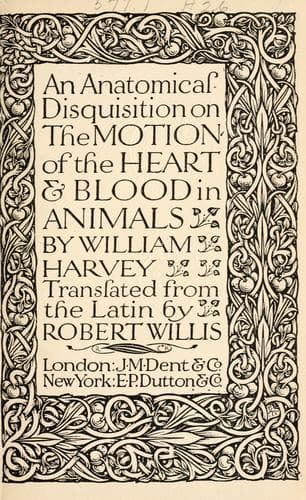
An anatomical disquisition on the motion of the heart & blood in animalsHarvey, William
Science
An anatomical disquisition on the motion of the heart & blood in animals
Harvey, William
Blood -- Circulation
It will not be foreign to the subject if I here show further, from
certain familiar reasonings, that the circulation is matter both
of convenience and necessity. In the first place, since death is a
corruption which takes place through deficiency of heat,[30] and since
all living things are warm, all dying things cold, there must be a
particular seat and fountain, a kind of home and hearth, where the
cherisher of nature, the original of the native fire, is stored and
preserved; whence heat and life are dispensed to all parts as from
a fountain head; whence sustenance may be derived; and upon which
concoction and nutrition, and all vegetative energy may depend. Now,
that the heart is this place, that the heart is the principle of life,
and that all passes in the manner just mentioned, I trust no one will
deny.
[30] Aristoteles De Respiratione, lib. ii et iii: De Part. Animal. et
alibi.
The blood, therefore, required to have motion, and indeed such a motion
that it should return again to the heart; for sent to the external
parts of the body far from its fountain, as Aristotle says, and without
motion, it would become congealed. For we see motion generating and
keeping up heat and spirits under all circumstances, and rest allowing
them to escape and be dissipated. The blood, therefore, become thick or
congealed by the cold of the extreme and outward parts, and robbed of
its spirits, just as it is in the dead, it was imperative that from its
fount and origin, it should again receive heat and spirits, and all
else requisite to its preservation--that, by returning, it should be
renovated and restored.
We frequently see how the extremities are chilled by the external
cold, how the nose and cheeks and hands look blue, and how the blood,
stagnating in them as in the pendent or lower parts of a corpse,
becomes of a dusky hue; the limbs at the same time getting torpid, so
that they can scarcely be moved, and seem almost to have lost their
vitality. Now they can by no means be so effectually, and especially
so speedily restored to heat and colour and life, as by a new afflux
and appulsion of heat from its source. But how can parts attract in
which the heat and life are almost extinct? Or how should they whose
passages are filled with condensed and frigid blood, admit fresh
aliment--renovated blood--unless they had first got rid of their old
contents? Unless the heart were truly that fountain where life and heat
are restored to the refrigerated fluid, and whence new blood, warm,
imbued with spirits, being sent out by the arteries, that which has
become cooled and effete is forced on, and all the particles recover
their heat which was failing, and their vital stimulus well-nigh
exhausted.
Public-domain text, read in full here on John Shaqi.
Reviews
Reviews
No reviews yet
Be the first to share your thoughts on this work.
Elsewhere in the archive
Join the Discussion
Join the discussion
Sign in to leave a comment or review.
Sign InorCreate an account