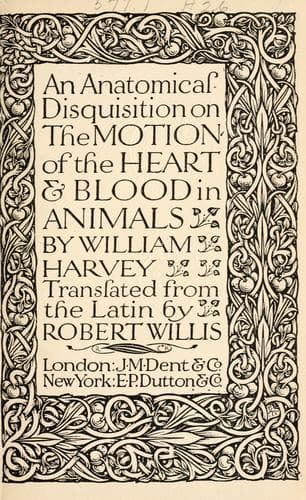
An anatomical disquisition on the motion of the heart & blood in animalsHarvey, William
Science
An anatomical disquisition on the motion of the heart & blood in animals
Harvey, William
Blood -- Circulation
Hence it is that if the heart be unaffected, life and health may be
restored to almost all the other parts of the body; but the heart
being chilled, or smitten with any serious disease, it seems a matter
of necessity that the whole animal fabric should suffer and fall into
decay. When the source is corrupted, there is nothing, as Aristotle
says,[31] which can be of service either to it or aught that depends
on it. And hence, by the way, it may perchance be wherefore grief,
and love, and envy, and anxiety, and all affections of the mind of
a similar kind are accompanied with emaciation and decay, or with
cacochemy and crudity, which engender all manner of diseases and
consume the body of man. For every affection of the mind that is
attended with either pain or pleasure, hope or fear, is the cause of
an agitation whose influence extends to the heart, and there induces
change from the natural constitution, in the temperature, the pulse
and the rest, which impairing all nutrition in its source and abating
the powers at large, it is no wonder that various forms of incurable
disease in the extremities and in the trunk are the consequence,
inasmuch as in such circumstances the whole body labours under the
effects of vitiated nutrition and a want of native heat.
[31] De Part. Animal. iii.
Moreover, when we see that all animals live through food concocted in
their interior, it is imperative that the digestion and distribution be
perfect; and, as a consequence, that there be a place and receptacle
where the aliment is perfected and whence it is distributed to the
several members. Now this place is the heart, for it is the only organ
in the body which contains blood for the general use; all the others
receive it merely for their peculiar or private advantage, just as the
heart also has a supply for its own especial behoof in its coronary
veins and arteries; but it is of the store which the heart contains
in its auricles and ventricles that I here speak; and then the heart
is the only organ which is so situated and constituted that it can
distribute the blood in due proportion to the several parts of the
body, the quantity sent to each being according to the dimensions
of the artery which supplies it, the heart serving as a magazine or
fountain ready to meet its demands.
Public-domain text, read in full here on John Shaqi.
Reviews
Reviews
No reviews yet
Be the first to share your thoughts on this work.
Elsewhere in the archive
Join the Discussion
Join the discussion
Sign in to leave a comment or review.
Sign InorCreate an account