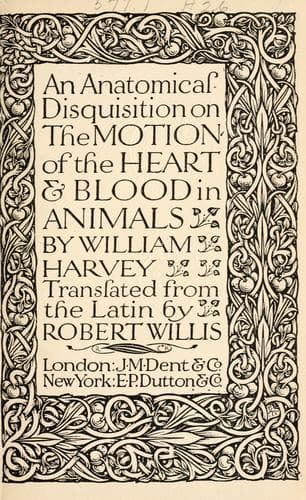
An anatomical disquisition on the motion of the heart & blood in animalsHarvey, William
Science
An anatomical disquisition on the motion of the heart & blood in animals
Harvey, William
Blood -- Circulation
In tertian fever, the morbific cause seeking the heart in the first
instance, and hanging about the heart and lungs, renders the patient
short-winded, disposed to sighing, indisposed to exertion; because
the vital principle is oppressed and the blood forced into the lungs
and rendered thick, does not pass through their substance, (as I
have myself seen in opening the bodies of those who had died in the
beginning of the attack,) when the pulse is always frequent, small,
and occasionally irregular; but the heat increasing, the matter
becoming attenuated, the passages forced, and the transit made, the
whole body begins to rise in temperature, and the pulse becomes
fuller, stronger--the febrile paroxysm is fully formed, whilst the
preternatural heat kindled in the heart, is thence diffused by the
arteries through the whole body along with the morbific matter, which
is in this way overcome and dissolved by nature.
When we perceive, further, that medicines applied externally exert
their influence on the body just as if they had been taken internally,
the truth we are contending for is confirmed. Colocynth and aloes
[applied externally] move the belly, cantharides excites the urine,
garlic applied to the soles of the feet assists expectoration, cordials
strengthen, and an infinite number of examples of the same kind might
be cited. It will not, therefore, be found unreasonable perchance, if
we say that the veins, by means of their orifices, absorb some of the
things that are applied externally and carry this inwards with the
blood, not otherwise, it may be, than those of the mesentery imbibe
the chyle from the intestines and carry it mixed with the blood to the
liver. For the blood entering the mesentery by the cœliac artery, and
the superior and inferior mesenterics, proceeds to the intestines, from
which, along with the chyle that has been attracted into the veins,
it returns by their numerous ramifications into the vena portæ of the
liver, and from this into the vena cava, and this in such wise that the
blood in these veins has the same colour and consistency as in other
veins, in opposition to what many believe to be the fact. Nor indeed
can we imagine two contrary motions in any capillary system--the chyle
upwards, the blood downwards. This could scarcely take place, and
must be held as altogether improbable. But is not the thing rather
arranged as it is by the consummate providence of nature? For were
the chyle mingled with the blood, the crude with the concocted, in
equal proportions, the result would not be concoction, transmutation,
and sanguification, but rather, and because they are severally active
and passive, a mixture or combination, or medium compound of the two,
precisely as happens when wine is mixed with water and syrup. But when
a very minute quantity of chyle is mingled with a very large quantity
of circulating blood, a quantity of chyle that bears no kind of
proportion to the mass of blood, the effect is the same, as Aristotle
Public-domain text, read in full here on John Shaqi.
Reviews
Reviews
No reviews yet
Be the first to share your thoughts on this work.
Elsewhere in the archive
Join the Discussion
Join the discussion
Sign in to leave a comment or review.
Sign InorCreate an account