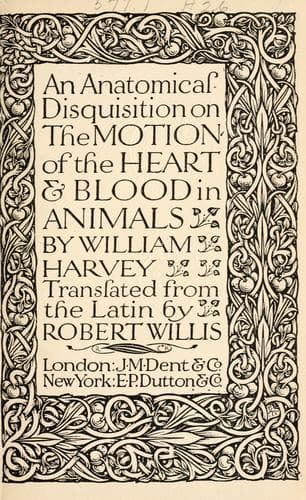
An anatomical disquisition on the motion of the heart & blood in animalsHarvey, William
Science
An anatomical disquisition on the motion of the heart & blood in animals
Harvey, William
Blood -- Circulation
says, as when a drop of water is added to a cask of wine, or the
contrary; the mass does not then present itself as a mixture, but is
still sensibly either wine or water. So in the mesenteric veins of an
animal we do not find either chyme or chyle and blood, blended together
or distinct, but only blood, the same in colour, consistency, and other
sensible properties, as it appears in the veins generally. Still as
there is a certain though small and inappreciable proportion of chyle
or unconcocted matter mingled with this blood, nature has interposed
the liver, in whose meandering channels it suffers delay and undergoes
additional change, lest arriving prematurely and crude at the heart,
it should oppress the vital principle. Hence in the embryo, there is
almost no use for the liver, but the umbilical vein passes directly
through, a foramen or anastomosis existing from the vena portæ, so
that the blood returns from the intestines of the fœtus, not through
the liver, but into the umbilical vein mentioned, and flows at once
into the heart, mingled with the natural blood which is returning from
the placenta; whence also it is that in the development of the fœtus
the liver is one of the organs that is last formed; I have observed
all the members perfectly marked out in the human fœtus, even the
genital organs, whilst there was yet scarcely any trace of the liver.
And indeed at the period when all the parts, like the heart itself
in the beginning, are still white, and save in the veins there is no
appearance of redness, you shall see nothing in the seat of the liver
but a shapeless collection, as it were, of extravasated blood, which
you might take for the effects of a contusion or ruptured vein.
But in the incubated egg there are, as it were, two umbilical vessels,
one from the albumen passing entire through the liver, and going
straight to the heart; another from the yelk, ending in the vena portæ;
for it appears that the chick, in the first instance, is entirely
formed and nourished by the white; but by the yelk after it has come to
perfection and is excluded from the shell; for this part may still be
found in the abdomen of the chick many days after its exclusion, and is
a substitute for the milk to other animals.
Public-domain text, read in full here on John Shaqi.
Reviews
Reviews
No reviews yet
Be the first to share your thoughts on this work.
Elsewhere in the archive
Join the Discussion
Join the discussion
Sign in to leave a comment or review.
Sign InorCreate an account