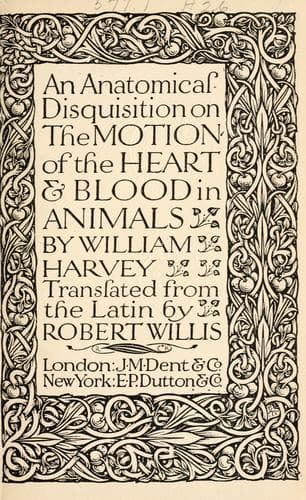
An anatomical disquisition on the motion of the heart & blood in animalsHarvey, William
Science
An anatomical disquisition on the motion of the heart & blood in animals
Harvey, William
Blood -- Circulation
There are further within the heart numerous braces, so to speak,
fleshy columns and fibrous bands, which Aristotle, in his third book
on Respiration, and the Parts of Animals, entitles nerves. These are
variously extended, and are either distinct or contained in grooves
in the walls and partition, where they occasion numerous pits or
depressions. They constitute a kind of small muscles, which are
superadded and supplementary to the heart, assisting it to execute a
more powerful and perfect contraction, and so proving subservient to
the complete expulsion of the blood. They are in some sort like the
elaborate and artful arrangement of ropes in a ship, bracing the heart
on every side as it contracts, and so enabling it more effectually
and forcibly to expel the charge of blood from its ventricles. This
much is plain, at all events, that some animals have them strongly
marked, others have them less so; and, in all that have them, they are
more numerous and stronger in the left than in the right ventricle;
and whilst some have them in the left, there are yet none present
in the right ventricle. In the human subject, again, these fleshy
columns and braces are more numerous in the left than in the right
ventricle, and they are more abundant in the ventricles than in the
auricles; occasionally, indeed, in the auricles there appear to be none
present whatsoever. In large, more muscular and hardier bodies, as of
countrymen, they are numerous; in more slender frames and in females
they are fewer.
In those animals in which the ventricles of the heart are smooth
within, and entirely without fibres or muscular bands, or anything like
foveæ, as in almost all the smaller birds, the partridge and the common
fowl, serpents, frogs, tortoises, and also fishes, for the major part,
there are no chordæ tendineæ, nor bundles of fibres, neither are there
any tricuspid valves in the ventricles.
Public-domain text, read in full here on John Shaqi.
Reviews
Reviews
No reviews yet
Be the first to share your thoughts on this work.
Elsewhere in the archive
Join the Discussion
Join the discussion
Sign in to leave a comment or review.
Sign InorCreate an account