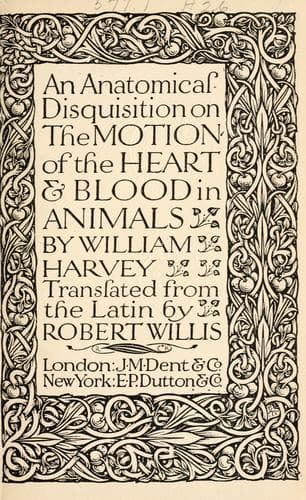
An anatomical disquisition on the motion of the heart & blood in animalsHarvey, William
Science
An anatomical disquisition on the motion of the heart & blood in animals
Harvey, William
Blood -- Circulation
Some animals have the right ventricle smooth internally, but the left
provided with fibrous bands, such as the goose, swan, and larger birds;
and the reason here is still the same as elsewhere, as the lungs are
spongy, and loose, and soft, no great amount of force is required to
force the blood through them; hence the right ventricle is either
without the bundles in question, or they are fewer and weaker, not
so fleshy or like muscles; those of the left ventricle, however, are
both stronger and more numerous, more fleshy and muscular, because the
left ventricle requires to be stronger, inasmuch as the blood which
it propels has to be driven through the whole body. And this, too, is
the reason why the left ventricle occupies the middle of the heart,
and has parietes three times thicker and stronger than those of the
right. Hence all animals--and among men it is not otherwise--that
are endowed with particularly strong frames, and that have large and
fleshy limbs at a great distance from the heart, have this central
organ of greater thickness, strength, and muscularity. And this is both
obvious and necessary. Those, on the contrary, that are of softer and
more slender make have the heart more flaccid, softer, and internally
either sparely or not at all fibrous. Consider farther the use of
the several valves, which are all so arranged, that the blood once
received into the ventricles of the heart shall never regurgitate,
once forced into the pulmonary artery and aorta shall not flow back
upon the ventricles. When the valves are raised and brought together
they form a three-cornered line, such as is left by the bite of a
leech; and the more they are forced, the more firmly do they oppose
the passage of the blood. The tricuspid valves are placed, like
gate-keepers, at the entrance into the ventricles, from the venæ cavæ
and pulmonary veins; lest the blood when most forcibly impelled should
flow back; and it is for this reason that they are not found in all
animals; neither do they appear to have been constructed with equal
care in all the animals in which they are found; in some they are more
accurately fitted, in others more remissly or carelessly contrived,
and always with a view to their being closed under a greater or a
slighter force of the ventricle. In the left ventricle, therefore,
and in order that the occlusion may be the more perfect against the
greater impulse, there are only two valves, like a mitre, and produced
into an elongated cone, so that they come together and touch to their
middle; a circumstance which perhaps led Aristotle into the error
of supposing this ventricle to be double, the division taking place
transversely. For the same reason, indeed, and that the blood may
not regurgitate upon the pulmonary veins, and thus the force of the
ventricle in propelling the blood through the system at large come to
be neutralized, it is that these mitral valves excel those of the right
Public-domain text, read in full here on John Shaqi.
Reviews
Reviews
No reviews yet
Be the first to share your thoughts on this work.
Elsewhere in the archive
Join the Discussion
Join the discussion
Sign in to leave a comment or review.
Sign InorCreate an account