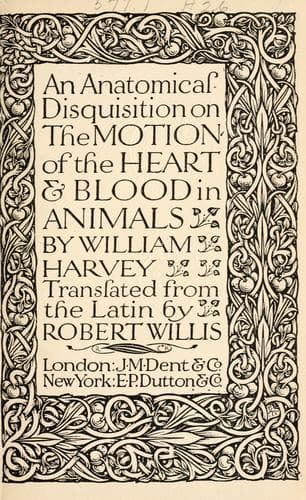
An anatomical disquisition on the motion of the heart & blood in animalsHarvey, William
Science
An anatomical disquisition on the motion of the heart & blood in animals
Harvey, William
Blood -- Circulation
Thus nature, ever perfect and divine, doing nothing in vain, has
neither given a heart where it was not required, nor produced it
before its office had become necessary; but by the same stages in the
development of every animal, passing through the constitutions of all,
as I may say (ovum, worm, fœtus), it acquires perfection in each. These
points will be found elsewhere confirmed by numerous observations on
the formation of the fœtus.
Finally, it was not without good grounds that Hippocrates, in his book,
“De Corde,” intitles it a muscle; as its action is the same, so is its
function, viz. to contract and move something else, in this case, the
charge of blood.
Farther, as in muscles at large, so can we infer the action and use
of the heart from the arrangement of its fibres and its general
structure. All anatomists admit with Galen that the body of the heart
is made up of various courses of fibres running straight, obliquely,
and transversely, with reference to one another; but in a heart which
has been boiled the arrangement of the fibres is seen to be different:
all the fibres in the parietes and septum are circular, as in the
sphincters; those, again, which are in the columnæ extend lengthwise,
and are oblique longitudinally; and so it comes to pass, that when all
the fibres contract simultaneously, the apex of the cone is pulled
towards its base by the columnæ, the walls are drawn circularly
together into a globe, the whole heart in short is contracted, and the
ventricles narrowed; it is therefore impossible not to perceive that,
as the action of the organ is so plainly contraction, its function is
to propel the blood into the arteries.
Nor are we the less to agree with Aristotle in regard to the
sovereignty of the heart; nor are we to inquire whether it receives
sense and motion from the brain? whether blood from the liver? whether
it be the origin of the veins and of the blood? and more of the same
description. They who affirm these propositions against Aristotle,
overlook, or do not rightly understand the principal argument, to the
effect that the heart is the first part which exists, and that it
contains within itself blood, life, sensation, motion, before either
the brain or the liver were in being, or had appeared distinctly, or,
at all events, before they could perform any function. The heart, ready
furnished with its proper organs of motion, like a kind of internal
creature, is of a date anterior to the body: first formed, nature
willed that it should afterwards fashion, nourish, preserve, complete
the entire animal, as its work and dwelling place: the heart, like
the prince in a kingdom, in whose hands lie the chief and highest
authority, rules over all; it is the original and foundation from which
all power is derived, on which all power depends in the animal body.
Public-domain text, read in full here on John Shaqi.
Reviews
Reviews
No reviews yet
Be the first to share your thoughts on this work.
Elsewhere in the archive
Join the Discussion
Join the discussion
Sign in to leave a comment or review.
Sign InorCreate an account