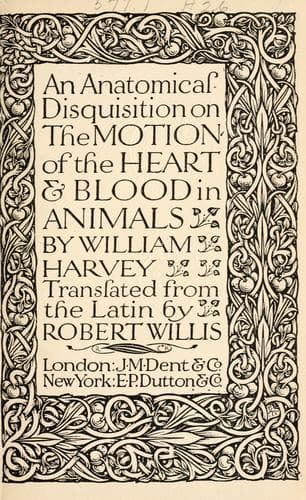
An anatomical disquisition on the motion of the heart & blood in animalsHarvey, William
Science
An anatomical disquisition on the motion of the heart & blood in animals
Harvey, William
Blood -- Circulation
was acquainted with the muscles, and did not unadvisedly refer all
motion in animals to the nerves, or to the contractile element, and
therefore called those little bands in the heart nerves--all this,
if I am permitted to proceed in my purpose of making a particular
demonstration of the organs of motion in animals from observations in
my possession, I trust I shall be able to make sufficiently plain.
[34] In the book, de Spiritu, and elsewhere.
But that we may go on with the subject we have in hand, viz. the use of
the auricles in filling the ventricles: we should expect that the more
dense and compact the heart, the thicker its parietes, the stronger
and more muscular must be the auricle to force and fill it, and _vice
versa_. Now this is actually so: in some the auricle presents itself
as a sanguinolent vesicle, as a thin membrane containing blood, as in
fishes, in which the sac that stands in lieu of the auricle, is of such
delicacy and ample capacity, that it seems to be suspended or to float
above the heart; in those fishes in which the sac is somewhat more
fleshy, as in the carp, barbel, tench, and others, it bears a wonderful
and strong resemblance to the lungs.
In some men of sturdier frame and stouter make, the right auricle is
so strong, and so curiously constructed within of bands and variously
interlacing fibres, that it seems to equal the ventricle of the heart
in other subjects; and I must say that I am astonished to find such
diversity in this particular in different individuals. It is to be
observed, however, that in the fœtus the auricles are out of all
proportion large, which is because they are present before the heart
[the ventricular portion] makes its appearance or suffices for its
office even when it has appeared, and they therefore have, as it were,
the duty of the whole heart committed to them, as has already been
demonstrated. But what I have observed in the formation of the fœtus as
before remarked (and Aristotle had already confirmed all in studying
the incubated egg,) throws the greatest light and likelihood upon the
point. Whilst the fœtus is yet in the guise of a soft worm, or, as is
commonly said, in the milk, there is a mere bloody point or pulsating
vesicle, a portion apparently of the umbilical vein, dilated at its
commencement or base; by and by, when the outline of the fœtus is
distinctly indicated, and it begins to have greater bodily consistence,
the vesicle in question having become more fleshy and stronger, and
changed its position, passes into the auricles, over or upon which
the body of the heart begins to sprout, though as yet it apparently
performs no duty; but when the fœtus is farther advanced, when the
bones can be distinguished from the soft parts, and movements take
place, then it has also a heart internately which pulsates, and, as I
have said, throws blood by either ventricle from the vena cava into the
arteries.
Public-domain text, read in full here on John Shaqi.
Reviews
Reviews
No reviews yet
Be the first to share your thoughts on this work.
Elsewhere in the archive
Join the Discussion
Join the discussion
Sign in to leave a comment or review.
Sign InorCreate an account