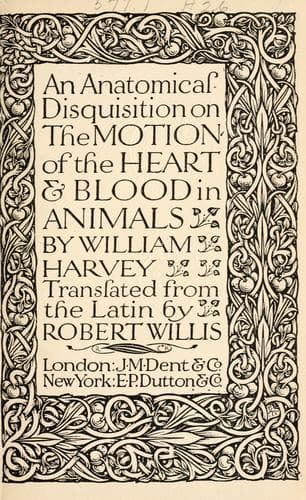
An anatomical disquisition on the motion of the heart & blood in animalsHarvey, William
Science
An anatomical disquisition on the motion of the heart & blood in animals
Harvey, William
Blood -- Circulation
That so much of the blood must remain as is appropriated to the
nutrition of the tissues, is matter of necessity; for it cannot nourish
unless it be assimilated and become coherent, and form substance in
lieu of that which is lost; but that the whole of the blood which flows
into a part should there remain, in order that so small a portion
should undergo transformation, is nowise necessary; for no part uses so
much blood for its nutrition as is contained in its arteries, veins,
and interstices. Nor because the blood is continually coming and going
is it necessary to suppose that it leaves nothing for nutriment behind
it. Consequently it is by no means necessary that the whole remain
in order that nutrition be effected. But our learned author, in the
same book, where he affirms so much, appears almost everywhere else to
assert the contrary. In that paragraph especially where he describes
the circulation in the brain, he says: “And the brain by means of
the circulation sends back blood to the heart, and thus refrigerates
the organ.” And in the same way are all the more remote parts said
to refrigerate the heart; thus in fevers, when the præcordia are
scorched and burn with febrile heat, patients baring their limbs and
casting off the bedclothes, seek to cool their heart; and the blood
generally, tempered and cooled down, as our learned author states it to
be with reference to the brain in particular, returns by the veins and
refrigerates the heart. Our author, therefore, appears to insinuate a
certain necessity for a circulation from every part, as well as from
the brain, in opposition to what he had before said in very precise
terms. But then he cautiously and ambiguously asserts, that the
blood does not return from the parts composing the second and third
regions, unless, as he says, it is drawn by force, and through a signal
deficiency of blood in the larger vessels, &c., which is most true if
these words be rightly understood; for by the larger vessels, in which
the deficiency is said to cause the reflux, I think he must be held to
mean the veins not the arteries; for the arteries are never emptied,
save into the veins or interstices of parts, but are incessantly filled
by the strokes of the heart; but in the vena cava and other returning
channels, in which the blood glides rapidly on, hastening to the heart,
there would speedily be a great deficiency of blood did not every part
incessantly restore the blood that is incessantly poured into it. Add
to this, that by the impulse of the blood which is forced with each
stroke into every part of the second and third regions, that which
is contained in the pores or interstices is urged into the smaller
veins, from which it passes into larger vessels, its motion assisted
besides by the motion and pressure of circumjacent parts; for from
every containing thing compressed and constringed, contained matters
are forced out. And thus it is that by the motions of the muscles
Public-domain text, read in full here on John Shaqi.
Reviews
Reviews
No reviews yet
Be the first to share your thoughts on this work.
Elsewhere in the archive
Join the Discussion
Join the discussion
Sign in to leave a comment or review.
Sign InorCreate an account