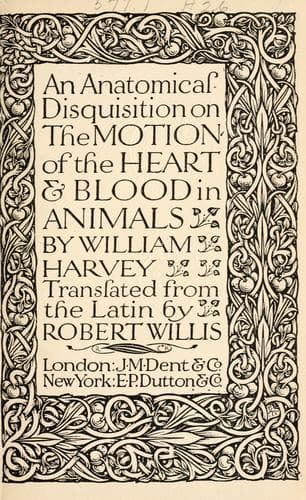
An anatomical disquisition on the motion of the heart & blood in animalsHarvey, William
Science
An anatomical disquisition on the motion of the heart & blood in animals
Harvey, William
Blood -- Circulation
Our learned author mentions a certain tract of his on the Circulation
of the Blood: I wish I could obtain a sight of it; perhaps I might
retract. But had the learned writer been so disposed, I do not see
but that having admitted the circular motion of the blood,[42] all
the difficulties which were formerly felt in connexion with the
distribution of the chyle and the blood by the same channels are
brought to an equally satisfactory solution; so much so indeed that
there would be no necessity for inquiring after or laying down any
separate vessels for the chyle. Even as the umbilical veins absorb the
nutritive juices from the fluids of the egg and transport them for
the nutrition and growth of the chick, in its embryo state, so do the
meseraic veins suck up the chyle from the intestines and transfer it to
the liver; and why should we not maintain that they perform the same
office in the adult? For all the mooted difficulties vanish when we
cease to suppose two contrary motions in the same vessels, and admit
but one and the same continuous motion in the mesenteric vessels from
the intestines to the liver.
[42] Enchiridion, lib. iii, cap. 8: “The blood incessantly and
naturally ascends or flows back to the heart in the veins, as in the
arteries it descends or departs from the heart.”
I shall elsewhere state my views of the lacteal veins when I treat of
the milk found in different parts of new-born animals, especially of
the human subject; for it is met with in the mesentery and all its
glands, in the thymus, in the axillæ, also in the breasts of infants.
This milk the midwifes are in the habit of pressing out, for the
health, as they believe, of the infants. But it has pleased the learned
Riolanus, not only to take away circulation from the blood contained in
the mesentery; he affirms that neither do the vessels in continuation
of the vena cava, nor the arteries, nor any of the parts of the
second and third regions, admit of circulation, so that he entitles
and enumerates as circulating vessels the vena cava and aorta only.
For this he appears to me to give a very indifferent reason:[43] “The
blood,” he says, “effused into all the parts of the second and third
regions, remains there for their nutrition; nor does it return to the
great vessels, unless forcibly drawn back by an extreme dearth of blood
in the great vessels, nor, unless carried by an impulse, does it flow
to the circulatory vessels.”
[43] Enchirid. lib. iii, cap. 8.
Public-domain text, read in full here on John Shaqi.
Reviews
Reviews
No reviews yet
Be the first to share your thoughts on this work.
Elsewhere in the archive
Join the Discussion
Join the discussion
Sign in to leave a comment or review.
Sign InorCreate an account