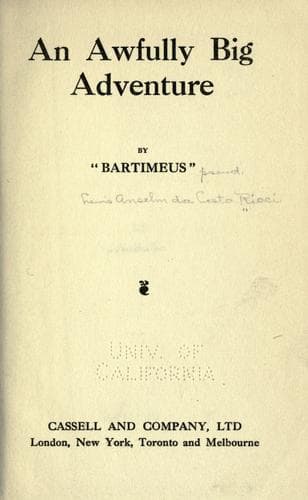
English fiction -- 20th century; Sea stories, English; War stories, English; World War, 1914-1918 -- Fiction
Curiously enough it was she who at last gave him his opportunity to
speak his heart. The children decreed it was time for their next
bathe, and while they undressed in the shelter of the rocks, Graeme
set about unpacking the tea-things and boiling the kettle. He
watched, kneeling, the three slim forms scamper across the short
stretch of sands in the sunlight to meet the incoming tide, and
suddenly Miss Mayne joined him on the cliff.
"I'll help you," she said; "I can watch the children from here and
cut bread and butter at the same time. They are quite safe."
Her manner was unconcerned; she spoke in the unrestrained note of
comradeship, and stood watching the children capering in the sunlit
waves, with the wind moulding her garments to her long limbs and
drawing loose tendrils of her hair in careless, happy disorder across
the curve of her cheek outlined against the sky.
Graeme knelt observing her, suddenly tongue-tied. You can invent
speeches to a goddess, aye, and deliver them effectively enough to a
silent night of stars, but this radiant, composed girl was flesh and
blood; he could almost see the warm vitality glowing through her
skin. She needed no clap-trap speech about love such as fellows
deliver in novels.... He rose to his feet. The wind and the
sunshine and the sound of the sea seemed to sing and shout together.
"Man! Here's your mate at last!" was the burden of the song.
"Here's the goal of all your heart's desire; the haven of your soul's
adventure! Look at her, shaped for you by incalculable forces and
laws, beautified and perfected and handed down through infinite ages,
to stand thus within your arms' reach. Yours, man, if you can but
win her! Tell her, fool ... tell her."
"I'm glad you came," said the fool, and his voice, husky and
unfamiliar, startled him.
A sound, distinct from the noises of wind and shore, obtruded upon
his consciousness as he spoke, and the girl heard it too, for she
wheeled sharply and stood staring, not at her companion, but back
across the sheep-cropped turf.
Two horses were approaching at a canter, near enough already for
their riders' faces to be discernible. One was Josephine Smedley;
the other, a vapid-faced young man in extravagant equestrian attire.
They drew rein and approached the cliff at a walk, Miss Smedley
waving her whip in greeting. Her companion touched his horse with
the spur, holding it on the curb while it curveted effectively.
"Topping day!" cried Josephine. "Watching the kids bathe, Mrs.
Jakes?"
Graeme heard the girl give a little gasp. She stood quite motionless
for a few seconds and then, still staring at the rider, he heard her
say in a low voice, as if speaking to herself: "This has gone far
enough; it's got to stop." Miss Smedley's cavalier had rather
overdone the spur business and was having considerable difficulty in
controlling his horse, which was plunging and pulling some distance
away.
Public-domain text, read in full here on John Shaqi.
Reviews
Reviews
No reviews yet
Be the first to share your thoughts on this work.
Join the Discussion
Join the discussion
Sign in to leave a comment or review.
Sign InorCreate an account