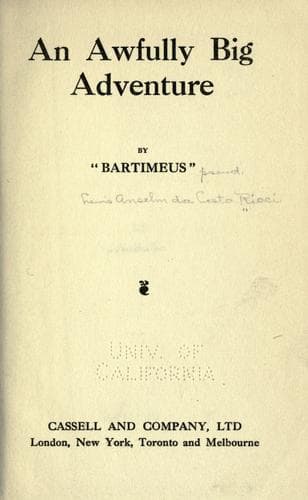
English fiction -- 20th century; Sea stories, English; War stories, English; World War, 1914-1918 -- Fiction
The sandal-maker stepped back among his wares. Punctiliously they
went through the little ceremony of genuflection and gesture.
Click-click went the clogs up the narrow street, and among the
shadows the sandal-maker stood with head bent, as if listening, long
after the sound had died away.
That evening a traveller came to the village, a little wizened man,
clad somewhat incongruously in a grey silk kimono, a bowler hat, and
elastic-sided boots. Rumour whispered that he was the owner of a
fashionable _cha-ya_ (tea-shop) in Tokyo, renowned for the beauty of
its Geishas. Gossip spreading quickly from door to door supplemented
this as the night wore on. The honourable stranger was touring the
country on the look-out for pretty girls. He paid well, they said,
and his establishment was much frequented by Europeans, who, as all
the world knows, part freely with the sen. Here was a chance for a
girl with looks!
The old gentleman was sipping saki in the guest-room of the village
inn when Su Su O was announced. His keen old eyes noted with
appreciation the lines of the childish figure as she bowed her
forehead to the matting. But when she raised herself to her knees,
and faced him with downcast eyes, he pursed up his mouth as if
contemplating a whistle. Had he been a European he probably would
have whistled, but this is not an art practised among owners of
_cha-ya_. Otherwise his face was expressionless.
"Who is your mother?" he inquired, breaking the silence.
"She is dead, most honourable one. A peasant woman. I reside at the
house of Matsu the charcoal-burner and his wife."
"And your father?"
"I do not know, O honourable one."
"Ah!" said her interlocutor, as if something had been explained that
he did not understand. Peasants do not beget daughters with hair
like Su Su O's, nor with ears like tiny pink shells, nor yet slender
wrists and fingers. "And you wish to be a Geisha?"
Su Su O prostrated herself in silent acquiescence.
"I will take you on condition that you remain with me three years."
The heart of Su Su O sank. Would Tani wait three years? "And I will
pay you"--he named what was to the girl a considerable sum. That
clinched it: with a dowry like this she could marry Tani over and
over again. Yet her fingers trembled as she painted her signature to
the indentures, and her heart was sick at the thought of the parting.
Even "passing his dwelling by" was better than never seeing it at
all. But she left for Tokyo the next day, and a few moments were all
that she had for saying good-bye.
"Oh, but you will wait?" she pleaded. "It will soon pass, the three
years, and I will come back rich, and--marry you, Tani."
Tani's reply, in flowery Japanese, was to the effect that he would
wait a hundred million years if necessary.
* * * * *
Public-domain text, read in full here on John Shaqi.
Reviews
Reviews
No reviews yet
Be the first to share your thoughts on this work.
Elsewhere in the archive
Join the Discussion
Join the discussion
Sign in to leave a comment or review.
Sign InorCreate an account