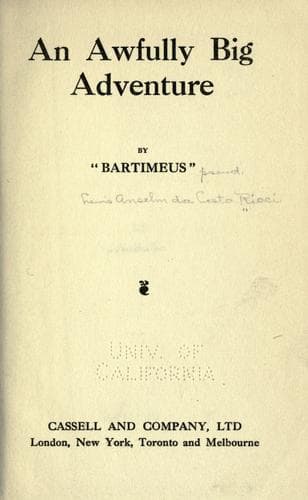
English fiction -- 20th century; Sea stories, English; War stories, English; World War, 1914-1918 -- Fiction
The sun was sinking low behind the peach-trees when workers from the
rice-fields came straggling back to the village. By twos and threes
they came, toil-stained women and boys, with here and there an old,
gnarled man, their shadows long on the road before them.
Tani, maker of sandals, looked up from his work as each one came
abreast his shop, responding gravely to the low-voiced, musical
greetings. But after the last worker had passed, his eyes, shaded
beneath the palm of his hand, still sought the road beyond the
village in patient expectancy.
Presently he heard the distant click of clogs, and a little figure
came in sight. Her cotton kimono was looped to the knees, the mud of
the paddy-fields still clung to her slender brown limbs. She drew
near.
"Greeting, Su Su O!"
"Greeting, Tani!" The girl paused before the shop, with quaint
genuflection and the gentle hiss of indrawn breath that in Japan is a
courtesy. The sandal-maker sat back on his heels.
"Tired, Su Su O?"
"Very," replied the girl. She moved the heavy, mud-caked hoe from
her shoulder and leaned on the haft, looking down at him with a
little smile. Her mouth, with its geranium-scarlet lips, drooped
wearily at the corners when in repose: her whole attitude betrayed
fatigue.
The man frowned. "It is not well, Su Su O, that you should do coolie
work. You are not of coolie stock, nor yet of coolie strength. Su
Su O, hearken yet again! Be my wife! Come and live with me here,
and let me labour for us both! I need you so, little Flower. I want
you for my wife ... not to see you only at sunrise and dusk, passing
my dwelling by."
The sun set swiftly; swiftly the purple night swept up over
rice-field and cherry-orchard. Here and there along the village
street a coloured lantern glowed suddenly out of the darkness;
through the frail oiled-paper walls of the cottages drifted the
voices of children and the tinkle of a samisen. The sandal-maker
stood up and took the girl's hand in his.
"I am lonely without you, Su Su O," he pleaded.
Her lip quivered. "I too am lonely, Tani; but I am a beggar--a
coolie girl without father or mother. I cannot marry you: I have no
dowry. I can bring nothing to the wedding--save myself, in rags. It
would bring disgrace upon us."
In vain he pleaded, all the poetic imagery of the Asiatic upon his
tongue. In vain he scoffed at convention--that terrible, inexorable
convention of the East; still the dainty head shook in plaintive
negation. Some unknown strain in her blood set honour before love,
bowed to the decrees that had ruled her unknown forbears. At length,
as if fearing that her resolution might weaken from sheer physical
weariness--and she loved very dearly too--she turned towards the
village.
"I must go, Tani. It is of no avail.... Nay, entreat me not
further.... Nay, Tani, I am so tired...."
Public-domain text, read in full here on John Shaqi.
Reviews
Reviews
No reviews yet
Be the first to share your thoughts on this work.
Elsewhere in the archive
Join the Discussion
Join the discussion
Sign in to leave a comment or review.
Sign InorCreate an account