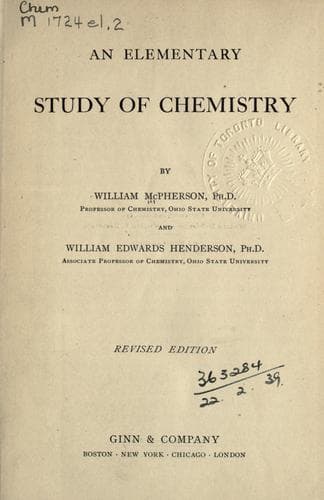
An Elementary Study of ChemistryMcPherson, William
Science
An Elementary Study of Chemistry
McPherson, William
Chemistry
1. _Action as an acid._ In aqueous solution hydrochloric acid has very
strong acid properties; indeed, it is one of the strongest acids. It
acts upon oxides and hydroxides, converting them into salts:
NaOH + HCl = NaCl + H_{2}O,
CuO + 2HCl = CuCl_{2} + H_{2}O.
It acts upon many metals, forming chlorides and liberating hydrogen:
Zn + 2HCl = ZnCl_{2} + 2H,
Al + 3HCl = AlCl_{3} + 3H.
Unlike nitric and sulphuric acids it has no oxidizing action, so that
when it acts on metals hydrogen is always given off.
2. _Relation to combustion._ Hydrochloric acid gas is not readily
decomposed, and is therefore neither combustible nor a supporter of
combustion.
3. _Action on oxidizing agents._ Although hydrochloric acid is
incombustible, it can be oxidized under some circumstances, in which
case the hydrogen combines with oxygen, while the chlorine is set free.
Thus, when a solution of hydrochloric acid acts upon manganese dioxide
part of the chlorine is set free:
MnO_{2} + 4HCl = MnCl_{2} + 2H_{2}O + 2Cl.
~Aqua regia.~ It has been seen that when nitric acid acts as an oxidizing
agent it usually decomposes, as represented in the equation
2HNO_{3} = H_{2}O + 2NO + 3O.
The oxygen so set free may act on hydrochloric acid:
6HCl + 3O = 3H_{2}O + 6Cl.
The complete equation therefore is
2HNO_{3} + 6HCl = 4H_{2}O + 2NO + 6Cl.
When concentrated nitric and hydrochloric acids are mixed this reaction
goes on slowly, chlorine and some other substances not represented in
the equation being formed. The mixture is known as _aqua regia_ and is
commonly prepared by adding one volume of nitric acid to three volumes
of hydrochloric acid. It acts more powerfully upon metals and other
substances than either of the acids separately, and owes its strength
not to acid properties but to the action of the nascent chlorine which
it liberates. Consequently, when it acts upon metals such as gold it
converts them into chlorides, and the reaction can be represented by
such equations as
Au + 3Cl = AuCl_{3}.
~Salts of hydrochloric acid,--chlorides.~ The chlorides of all the metals
are known and many of them are very important compounds. Some of them
are found in nature, and all can be prepared by the general method of
preparing salts. Silver chloride, lead chloride, and mercurous chloride
are insoluble in water and acids, and can be prepared by adding
hydrochloric acid to solutions of compounds of the respective elements.
While the chlorides have formulas similar to the fluorides, their
properties are often quite different. This is seen in the solubility of
the salts. Those metals whose chlorides are insoluble form soluble
fluorides, while many of the metals which form soluble chlorides form
insoluble fluorides.
Public-domain text, read in full here on John Shaqi.
Reviews
Reviews
No reviews yet
Be the first to share your thoughts on this work.
Elsewhere in the archive
Join the Discussion
Join the discussion
Sign in to leave a comment or review.
Sign InorCreate an account