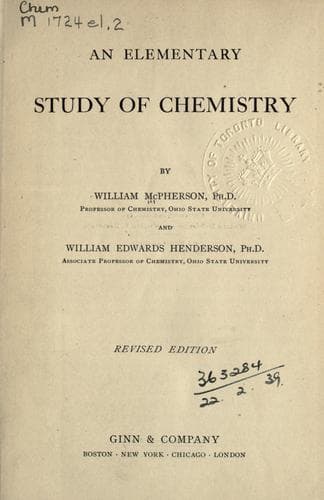
An Elementary Study of ChemistryMcPherson, William
Science
An Elementary Study of Chemistry
McPherson, William
Chemistry
~Compounds of chlorine with oxygen and hydrogen.~ Chlorine combines with
oxygen and hydrogen to form four different acids. They are all quite
unstable, and most of them cannot be prepared in pure form; their salts
can easily be made, however, and some of them will be met with in the
study of the metals. The formulas and names of these acids are as
follows:
HClO hypochlorous acid.
HClO_{2} chlorous acid.
HClO_{3} chloric acid.
HClO_{4} perchloric acid.
~Oxides of chlorine.~ Two oxides are known, having the formulas Cl_{2}O
and ClO_{2}. They decompose very easily and are good oxidizing agents.
BROMINE
~Historical.~ Bromine was discovered in 1826 by the French chemist
Ballard, who isolated it from sea salt. He named it bromine (stench)
because of its unbearable fumes.
~Occurrence.~ Bromine occurs almost entirely in the form of bromides,
especially as sodium bromide and magnesium bromide, which are found in
many salt springs and salt deposits. The Stassfurt deposits in Germany
and the salt waters of Ohio and Michigan are especially rich in
bromides.
~Preparation of bromine.~ The laboratory method of preparing bromine is
essentially different from the commercial method.
[Illustration Fig. 55]
1. _Laboratory method._ As in the case of chlorine, bromine can be
prepared by the action of hydrobromic acid (HBr) on manganese dioxide.
Since hydrobromic acid is not an article of commerce, a mixture of
sulphuric acid and a bromide is commonly substituted for it. The
materials are placed in a retort arranged as shown in Fig. 55. The end
of the retort just touches the surface of the water in the test tube. On
heating, the bromine distills over and is collected in the cold
receiver. The equation is
2NaBr + 2H_{2}SO_{4} + MnO_{2} = Na_{2}SO_{4} + MnSO_{4}
+ 2H_{2}O + 2Br.
2. _Commercial method._ Bromine is prepared commercially from the waters
of salt wells which are especially rich in bromides. On passing a
current of electricity through such waters the bromine is first
liberated. Any chlorine liberated, however, will assist in the reaction,
since free chlorine decomposes bromides, as shown in the equation
NaBr + Cl = NaCl + Br.
When the water containing the bromine is heated, the liberated bromine
distills over into the receiver.
~Physical properties.~ Bromine is a dark red liquid about three times as
heavy as water. Its vapor has a very offensive odor and is most
irritating to the eyes and throat. The liquid boils at 59 deg. and
solidifies at -7 deg.; but even at ordinary temperatures it evaporates
rapidly, forming a reddish-brown gas very similar to nitrogen peroxide
in appearance. Bromine is somewhat soluble in water, 100 volumes of
water under ordinary conditions dissolving 1 volume of the liquid. It is
readily soluble in carbon disulphide, forming a yellow solution.
Public-domain text, read in full here on John Shaqi.
Reviews
Reviews
No reviews yet
Be the first to share your thoughts on this work.
Elsewhere in the archive
Join the Discussion
Join the discussion
Sign in to leave a comment or review.
Sign InorCreate an account