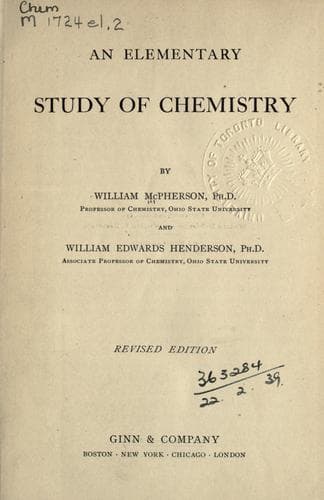
An Elementary Study of ChemistryMcPherson, William
Science
An Elementary Study of Chemistry
McPherson, William
Chemistry
~Carbon dioxide~ (CO_{2}). Carbon dioxide is present in the air to the
extent of about 3 parts in 10,000, and this apparently small amount is
of fundamental importance in nature. In some localities it escapes from
the earth in great quantities, and many spring waters carry large
amounts of it in solution. When these highly charged spring waters reach
the surface of the earth, and the pressure on them is removed, the
carbon dioxide escapes with effervescence. It is a product of the
oxidation of all organic matter, and is therefore formed in fires as
well as in the process of decay. It is thrown off from the lungs of all
animals in respiration, and is a product of many fermentation processes
such as vinegar making and brewing. Combined with metallic oxides it
forms vast deposits of carbonates in nature.
~Preparation.~ In the laboratory carbon dioxide is always prepared by the
action of an acid upon a carbonate, usually calcium carbonate, the
apparatus shown in Fig. 39 serving the purpose very well. This reaction
might be expected to produce carbonic acid, thus:
CaCO_{3} + 2HCl = CaCl_{2} + H_{2}CO_{3}.
Carbonic acid is very unstable, however, and decomposes into its
anhydride, CO_{2}, and water, thus:
H_{2}CO_{3} = H_{2}O + CO_{2}.
The complete reaction is represented by the equation
CaCO_{3} + 2HCl = CaCl_{2} + CO_{2} + H_{2}O.
~Physical properties.~ Carbon dioxide is a colorless, practically odorless
gas whose density is 1.5. Its weight may be inferred from the fact that
it can be siphoned, or poured like water, from one vessel downward into
another. At 15 deg. and under ordinary pressure it dissolves in its own
volume of water and imparts a somewhat biting, pungent taste to it. It
is easily condensed, and is now prepared commercially in this form by
pumping the gas into steel cylinders (see Fig. 6) which are kept cold
during the process. When the liquid is permitted to escape into the air
part of it instantly evaporates, and in so doing absorbs so much heat
that another portion is solidified, the solid form strikingly resembling
snow in appearance. This snow is very cold and mercury can easily be
frozen with it.
Public-domain text, read in full here on John Shaqi.
Reviews
Reviews
No reviews yet
Be the first to share your thoughts on this work.
Elsewhere in the archive
Join the Discussion
Join the discussion
Sign in to leave a comment or review.
Sign InorCreate an account