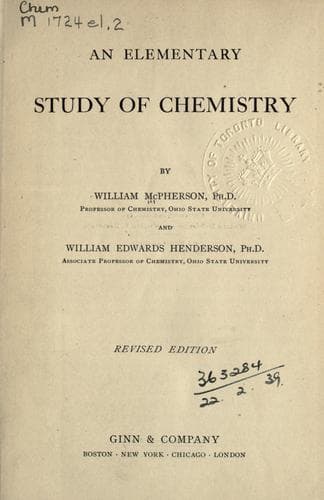
An Elementary Study of ChemistryMcPherson, William
Science
An Elementary Study of Chemistry
McPherson, William
Chemistry
~Solid carbon dioxide.~ Cylinders of liquid carbon dioxide are
inexpensive, and should be available in every school. To demonstrate the
properties of solid carbon dioxide, the cylinder should be placed across
the table and supported in such a way that the stopcock end is several
inches lower than the other end. A loose bag is made by holding the
corners of a handkerchief around the neck of the stopcock, and the cock
is then turned on so that the gas rushes out in large quantities. Very
quickly a considerable quantity of the snow collects in the
handkerchief. To freeze mercury, press a piece of filter paper into a
small evaporating dish and pour the mercury upon it. Coil a flat spiral
upon the end of a wire, and dip the spiral into the mercury. Place a
quantity of solid carbon dioxide upon the mercury and pour 10 cc.-15 cc.
of ether over it. In a minute or two the mercury will solidify and may
be removed from the dish by the wire serving as a handle. The filter
paper is to prevent the mercury from sticking to the dish; the ether
dissolves the solid carbon dioxide and promotes its rapid conversion
into gas.
~Chemical properties.~ Carbon dioxide is incombustible, since it is, like
water, a product of combustion. It does not support combustion, as does
nitrogen peroxide, because the oxygen in it is held in very firm
chemical union with the carbon. Very strong reducing agents, such as
highly heated carbon, can take away half of its oxygen:
CO_{2} + C = 2CO.
~Uses.~ The relation of carbon dioxide to plant life has been discussed in
a previous chapter. Water highly charged with carbon dioxide is used for
making soda water and similar beverages. Since it is a non-supporter of
combustion and can be generated readily, carbon dioxide is also used as
a fire extinguisher. Some of the portable fire extinguishers are simply
devices for generating large amounts of the gas. It is not necessary
that all the oxygen should be kept away from the fire in order to
smother it. A burning candle is extinguished in air which contains only
2.5% of carbon dioxide.
~Carbonic acid~ (H_{2}CO_{3}). Like most of the oxides of the non-metallic
elements, carbon dioxide is an acid anhydride. It combines with water to
form an acid of the formula H_{2}CO_{3}, called carbonic acid:
H_{2}O + CO_{2} = H_{2}CO_{3}.
The acid is, however, very unstable and cannot be isolated. Only a very
small amount of it is actually formed when carbon dioxide is passed into
water, as is evident from the small solubility of the gas. If, however,
a base is present in the water, salts of carbonic acid are formed, and
these are quite stable:
2NaOH + H_{2}O + CO_{2} = Na_{2}CO_{3} + 2H_{2}O.
~Action of carbon dioxide on bases.~ This conduct is explained by the
principles of reversible reactions. The equation
H_{2}O +CO_{2} <--> H_{2}CO_{3}
Public-domain text, read in full here on John Shaqi.
Reviews
Reviews
No reviews yet
Be the first to share your thoughts on this work.
Elsewhere in the archive
Join the Discussion
Join the discussion
Sign in to leave a comment or review.
Sign InorCreate an account