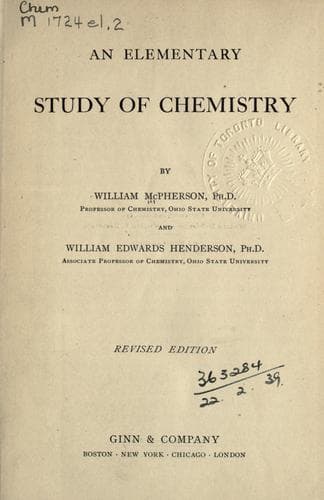
An Elementary Study of ChemistryMcPherson, William
Science
An Elementary Study of Chemistry
McPherson, William
Chemistry
is a reversible equation, and the extent to which the reaction
progresses depends upon the relative concentrations of each of the three
factors in it. Equilibrium is ordinarily reached when very little
H_{2}CO_{3} is formed. If a base is present in the water to combine with
the H_{2}CO_{3} as fast as it is formed, all of the CO_{2} is converted
into H_{2}CO_{3}, and thence into a carbonate.
~Salts of carbonic acid,--carbonates.~ The carbonates form a very
important class of salts. They are found in large quantities in nature,
and are often used in chemical processes. Only the carbonates of sodium,
potassium, and ammonium are soluble, and these can be made by the action
of carbon dioxide on solutions of the bases, as has just been explained.
The insoluble carbonates are formed as precipitates when soluble salts
are treated with a solution of a soluble carbonate. Thus the insoluble
calcium carbonate can be made by bringing together solutions of calcium
chloride and sodium carbonate:
CaCl_{2} + Na_{2}CO_{3} = CaCO_{3} + 2NaCl.
Most of the carbonates are decomposed by heat, yielding an oxide of the
metal and carbon dioxide. Thus lime (calcium oxide) is made by strongly
heating calcium carbonate:
CaCO_{3} = CaO + CO_{2}.
~Acid carbonates.~ Like all acids containing two acid hydrogen atoms,
carbonic acid can form both normal and acid salts. The acid carbonates
are made by treating a normal carbonate with an excess of carbonic acid.
With few exceptions they are very unstable, heat decomposing them even
when in solution.
~Action of carbon dioxide on calcium hydroxide.~ If carbon dioxide is
passed into clear lime water, calcium carbonate is at first
precipitated:
H_{2}O + CO_{2} = H_{2}CO_{3},
Ca(OH)_{2} + H_{2}CO_{3} = CaCO_{3} + 2H_{2}O.
Advantage is taken of this reaction in testing for the presence of
carbon dioxide, as already explained in the chapter on the atmosphere.
If the current of carbon dioxide is continued, the precipitate soon
dissolves, because the excess of carbonic acid forms calcium acid
carbonate which is soluble:
CaCO_{3} + H_{2}CO_{3} = Ca(HCO_{3})_{2}.
If now the solution is heated, the acid carbonate is decomposed and
calcium carbonate once more precipitated:
Ca(HCO_{3})_{2} = CaCO_{3} + H_{2}CO_{3}.
~Carbon monoxide (CO).~ Carbon monoxide can be made in a number of ways,
the most important of which are the three following:
1. _By the partial oxidation of carbon._ If a slow current of air is
conducted over highly heated carbon, the monoxide is formed, thus:
C + O = CO
It is therefore often formed in stoves when the air draught is
insufficient. Water gas, which contains large amounts of carbon
monoxide, is made by partially oxidizing carbon with steam:
C + H_{2}O = CO + 2H.
2. _By the partial reduction of carbon dioxide._ When carbon dioxide is
conducted over highly heated carbon it is reduced to carbon monoxide by
the excess of carbon:
CO_{2} + C = 2CO.
Public-domain text, read in full here on John Shaqi.
Reviews
Reviews
No reviews yet
Be the first to share your thoughts on this work.
Elsewhere in the archive
Join the Discussion
Join the discussion
Sign in to leave a comment or review.
Sign InorCreate an account