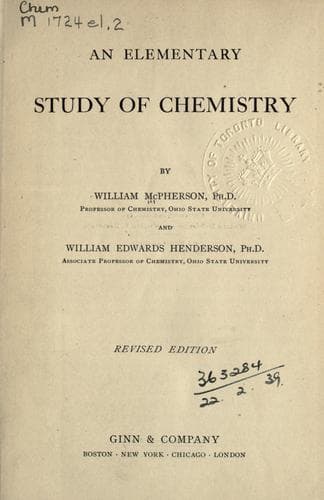
An Elementary Study of ChemistryMcPherson, William
Science
An Elementary Study of Chemistry
McPherson, William
Chemistry
Borax is extensively used as a constituent of enamels and glazes for
both metal ware and pottery. It is also used as a flux in soldering and
brazing, and in domestic ways it serves as a mild alkali, as a
preservative for meats, and in a great variety of less important
applications.
EXERCISES
1. Account for the fact that a solution of borax in water is alkaline.
2. What weight of water of crystallization does 1 kg. of borax contain?
3. When a concentrated solution of borax acts on silver nitrate a borate
of silver is formed. If the solution of borax is dilute, however, an
hydroxide of silver forms. Account for this difference in behavior.
CHAPTER XXII
THE METALS
~The metals.~ The elements which remain to be considered are known
collectively as the metals. They are also called the base-forming
elements, since their hydroxides are bases. A metal may therefore be
defined as an element whose hydroxide is a base. When a base dissolves
in water the hydroxyl groups form the anions, while the metallic element
forms the cations. From this standpoint a metal can be defined as an
element capable of forming simple cations in solution.
The distinction between a metal and a non-metal is not a very sharp one,
since the hydroxides of a number of elements act as bases under some
conditions and as acids under others. We have seen that antimony is an
element of this kind.
~Occurrence of metals in nature.~ A few of the metals are found in nature
in the free state. Among these are gold, platinum, and frequently
copper. They are usually found combined with other elements in the form
of oxides or salts of various acids. Silicates, carbonates, sulphides,
and sulphates are the most abundant salts. All inorganic substances
occurring in nature, whether they contain a metal or not, are called
_minerals_. Those minerals from which a useful substance can be
extracted are called _ores_ of the substance. These two terms are most
frequently used in connection with the metals.
~Extraction of metals,--metallurgy.~ The process of extracting a metal
from its ores is called the metallurgy of the metal. The metallurgy of
each metal presents peculiarities of its own, but there are several
methods of general application which are very frequently employed.
1. _Reduction of an oxide with carbon._ Many of the metals occur in
nature in the form of oxides. When these oxides are heated to a high
temperature with carbon the oxygen combines with it and the metal is set
free. Iron, for example, occurs largely in the form of the oxide
Fe_{2}O_{3}. When this is heated with carbon the reaction expressed in
the following equation takes place:
Fe_{2}O_{3} + 3 C = 2 Fe + 3 CO.
Public-domain text, read in full here on John Shaqi.
Reviews
Reviews
No reviews yet
Be the first to share your thoughts on this work.
Elsewhere in the archive
Join the Discussion
Join the discussion
Sign in to leave a comment or review.
Sign InorCreate an account