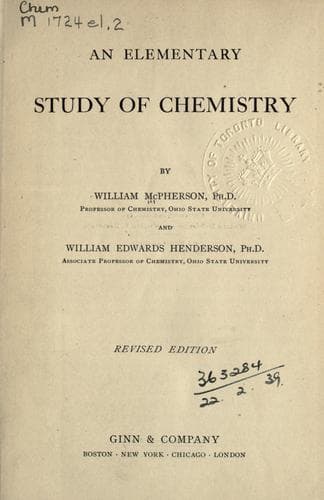
An Elementary Study of ChemistryMcPherson, William
Science
An Elementary Study of Chemistry
McPherson, William
Chemistry
The usual method for adding these elements to the steel is to first
prepare a very rich alloy of iron with the element to be added, and then
add enough of this alloy to a large quantity of the steel to bring it to
the desired composition. A rich alloy of iron with manganese or silicon
can be prepared directly in a blast furnace, and is called
ferromanganese or ferrosilicon. Similar alloys of iron with the other
elements mentioned are made in an electric furnace by reducing the mixed
oxides with carbon.
~Pure iron.~ Perfectly pure iron is rarely prepared and is not adapted to
commercial uses. It can be made by reducing pure oxide of iron in a
current of hydrogen at a high temperature. Prepared in this way it
forms a black powder; when melted it forms a tin-white metal which is
less fusible and more malleable than wrought iron. It is easily acted
upon by moist air.
~Compounds of iron.~ Iron differs from the metals so far studied in that
it is able to form two series of compounds in which the iron has two
different valences. In the one series the iron is divalent and forms
compounds which in formulas and many chemical properties are similar to
the corresponding zinc compounds. It can also act as a trivalent metal,
and in this condition forms salts similar to those of aluminium. Those
compounds in which the iron is divalent are known as _ferrous_
compounds, while those in which it is trivalent are known as _ferric_.
~Oxides of iron.~ Iron forms several oxides. Ferrous oxide (FeO) is not
found in nature, but can be prepared artificially in the form of a black
powder which easily takes up oxygen, forming ferric oxide:
2FeO + O = Fe_{2}O_{3}.
Ferric oxide is the most abundant ore of iron and occurs in great
deposits, especially in the Lake Superior region. It is found in many
mineral varieties which vary in density and color, the most abundant
being hematite, which ranges in color from red to nearly black. When
prepared by chemical processes it forms a red powder which is used as a
paint pigment (Venetian red) and as a polishing powder (rouge).
Magnetite has the formula Fe_{3}O_{4} and is a combination of FeO and
Fe_{2}O_{3}. It is a very valuable ore, but is less abundant than
hematite. It is sometimes called magnetic oxide of iron, or lodestone,
since it is a natural magnet.
~Ferrous salts.~ These salts are obtained by dissolving iron in the
appropriate acid, or, when insoluble, by precipitation. They are usually
light green in color and crystallize well. In chemical reactions they
are quite similar to the salts of magnesium and zinc, but differ from
them in one important respect, namely, that they are easily changed into
compounds in which the metal is trivalent. Thus ferrous chloride treated
with chlorine or aqua regia is changed into ferric chloride:
FeCl_{2} + Cl = FeCl_{3}.
Ferrous hydroxide exposed to moist air is rapidly changed into ferric
hydroxide:
2Fe(OH)_{2} + H_{2}O + O = 2Fe(OH)_{3}.
Public-domain text, read in full here on John Shaqi.
Reviews
Reviews
No reviews yet
Be the first to share your thoughts on this work.
Elsewhere in the archive
Join the Discussion
Join the discussion
Sign in to leave a comment or review.
Sign InorCreate an account