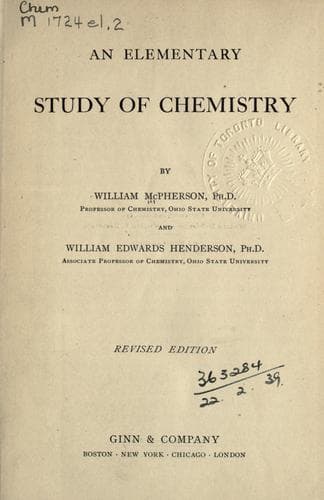
An Elementary Study of ChemistryMcPherson, William
Science
An Elementary Study of Chemistry
McPherson, William
Chemistry
~Ferrous sulphate~ _(copperas, green vitriol)_ (FeSO_{4}.7H_{2}O). Ferrous
sulphate is the most familiar ferrous compound. It is prepared
commercially as a by-product in the steel-plate mills. Steel plates are
cleaned by the action of dilute sulphuric acid upon them, and in the
process some of the iron dissolves. The liquors are concentrated and the
green vitriol separates from them.
~Ferrous sulphide~ (FeS). Ferrous sulphide is sometimes found in nature as
a golden-yellow crystalline mineral. It is formed as a black precipitate
when a soluble sulphide and an iron salt are brought together in
solution:
FeSO_{4} + Na_{2}S = FeS + Na_{2}SO_{4}.
It can also be made as a heavy dark-brown solid by fusing together the
requisite quantities of sulphur and iron. It is obtained as a by-product
in the metallurgy of lead:
PbS + Fe = FeS + Pb.
It is used in the laboratory in the preparation of hydrosulphuric acid:
FeS + 2HCl = FeCl_{2} + H_{2}S.
~Iron disulphide~ _(pyrites)_ (FeS_{2}). This substance bears the same
relation to ferrous sulphide that hydrogen dioxide does to water. It
occurs abundantly in nature in the form of brass-yellow cubical crystals
and in compact masses. Sometimes the name "fool's gold" is applied to it
from its superficial resemblance to the precious metal. It is used in
very large quantities as a source of sulphur dioxide in the manufacture
of sulphuric acid, since it burns readily in the air, forming ferric
oxide and sulphur dioxide:
2FeS_{2} + 11O = Fe_{2}O_{3} + 4SO_{2}.
~Ferrous carbonate~ (FeCO_{3}). This compound occurs in nature as
siderite, and is a valuable ore. It will dissolve to some extent in
water containing carbon dioxide, just as will calcium carbonate, and
waters containing it are called chalybeate waters. These chalybeate
waters are supposed to possess certain medicinal virtues and form an
important class of mineral waters.
~Ferric salts.~ Ferric salts are usually obtained by treating an acidified
solution of a ferrous salt with an oxidizing agent:
2FeCl_{2} + 2HCl + O = 2FeCl_{3} + H_{2}O,
2FeSO_{4} + H_{2}SO_{4} + O = Fe_{2}(SO_{4})_{3} + H_{2}O.
They are usually yellow or violet in color, are quite soluble, and as a
rule do not crystallize well. Heated with water in the absence of free
acid, they hydrolyze even more readily than the salts of aluminium. The
most familiar ferric salts are the chloride and the sulphate.
~Ferric chloride~ (FeCl_{3}). This salt can be obtained most conveniently
by dissolving iron in hydrochloric acid and then passing chlorine into
the solution:
Fe + 2HCl = FeCl_{2} + 2H,
FeCl_{2} + Cl = FeCl_{3}.
When the pure salt is heated with water it is partly hydrolyzed:
FeCl_{3} + 3 H_{2}O <--> Fe(OH)_{3} + 3HCl.
This is a reversible reaction, however, and hydrolysis can therefore be
prevented by first adding a considerable amount of the soluble product
of the reaction, namely, hydrochloric acid.
Public-domain text, read in full here on John Shaqi.
Reviews
Reviews
No reviews yet
Be the first to share your thoughts on this work.
Elsewhere in the archive
Join the Discussion
Join the discussion
Sign in to leave a comment or review.
Sign InorCreate an account